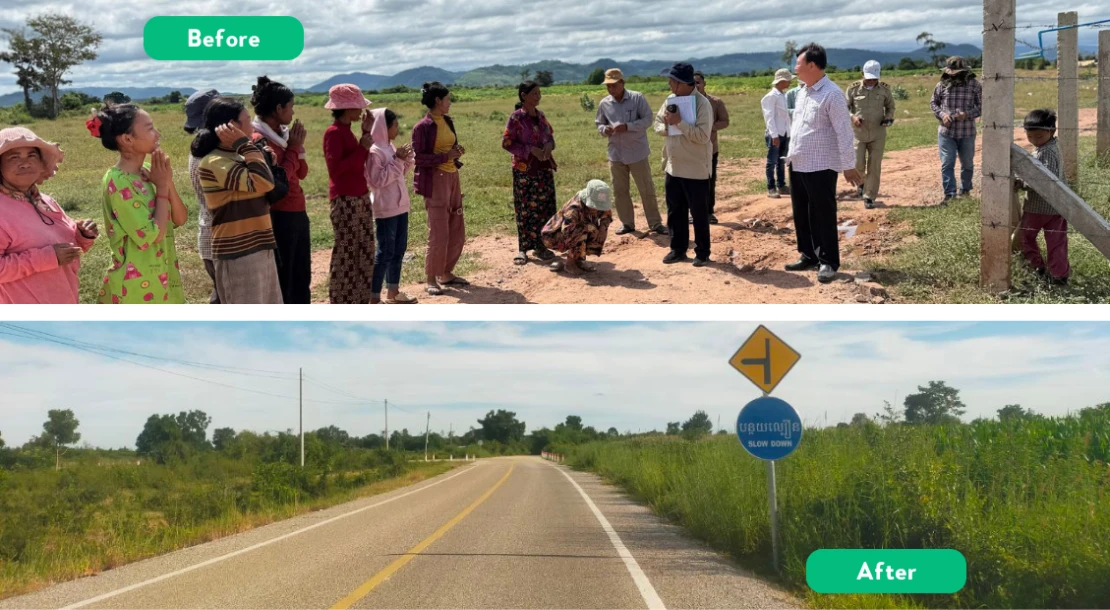

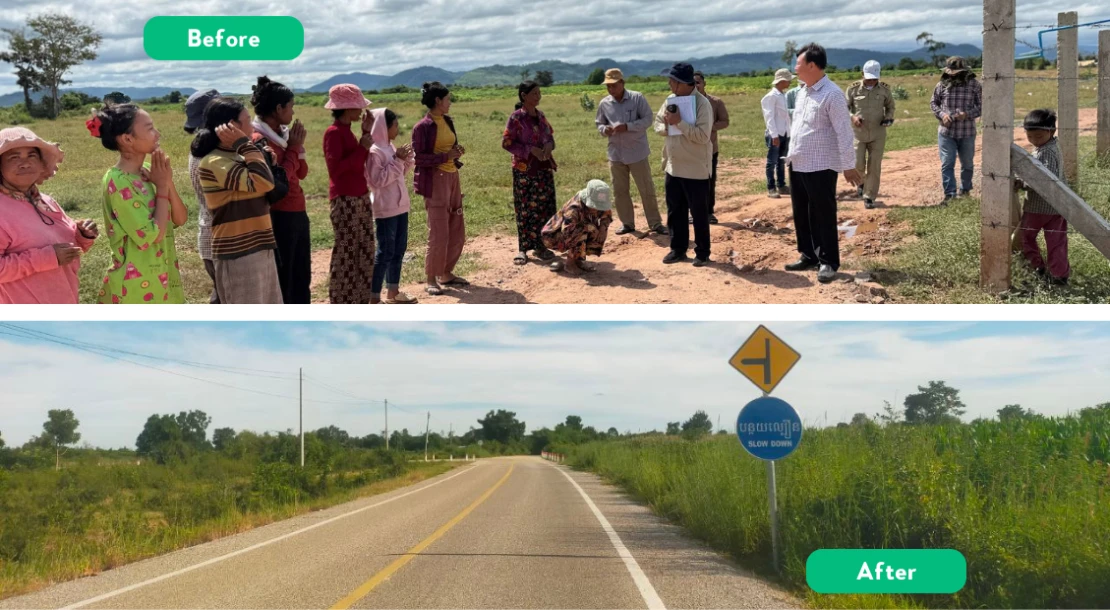
In rural Cambodia, poor road conditions have long hindered access to education, healthcare, markets and other essential services, especially for women.
A woman we spoke with in the Koh Kong province, Kanha, vice-chief of the Yun Min Chroy Svay Health Centre, says substandard roads make it hard for villagers to reach her facility: “The dust can be so bad that we have to keep all the windows and doors closed. Patients have become sick with things like the flu, coughs and even tuberculosis.”
Kanha’s experience underscores the challenges faced by women in rural Cambodia, where poor road connectivity limits access to education, healthcare, markets and other essential services. Seasonal flooding, intensified by climate change, further disrupts rural connectivity. For women already burdened with domestic chores and unpaid care work, extra travel time caused by bad roads can mean the difference between timely treatment and severe illness.
The National Restoration of Rural Productive Capacity Project, financed by the Asian Infrastructure Investment Bank (AIIB) and launched in 2020, has significantly improved access to essential services and opportunities. According to Kanha: “The rebuilt road has made it easier for us, health service providers, to deliver services such as mobile child vaccinations, maternal check-ups and health education on topics like nutrition, maternal and newborn care, immunization, and family planning. Referring patients to district and provincial hospitals is now much faster. What used to take two hours now takes only 30 to 45 minutes.”
Enhanced connectivity is also opening up new economic opportunities for rural women. Local entrepreneur Limheang, who leads ecotourism and seafood-processing initiatives, explained that better roads have boosted business: “We can now reach markets more quickly and at lower cost, which helps reduce damage to seafood during transport. Also, some traders now come directly to our villages to buy fish from us at home, allowing women to spend more time on other income-generating activities.”
Improved access is also attracting tourism, providing alternative income sources to residents through ecotourism and direct sale of local products at better prices. “We sell our seafood and other local products directly to tourists at better prices,” Limheang said. “With this new income, we now plan to expand our seafood processing to produce higher-value products like fish sauce and dried shrimp.”
The project’s positive impacts for local communities, especially women, are rooted in a careful gender-responsive design guided by AIIB’s Gender Action Plan (GAP), which was developed to integrate gender considerations into project implementation.
Suu Tran Quy, Social Development Specialist, Sustainability and Fiduciary Solutions Department, AIIB, explained: “The project developed a gender action plan based on consultations with local women. Many inputs received were integrated into the project design, such as activities to address traffic safety for women. The results monitoring framework includes gender-sensitive indicators focusing on women’s and men’s access to markets, health centers and schools to measure the project’s gender impact. Early in the process, these indicators were prioritized in the road selection, supported by strong project management leadership. The GAP was implemented and monitored over time, using sex-disaggregated data to track progress.”
To achieve gender outcomes on the ground, active participation by women and the local community is vital. Consultations with women during project preparation helped identify key access challenges and priorities. Project team leader Ankur Agrawal, Senior Investment Officer, Public Sector Clients Department, Region 1, AIIB, also highlighted women’s role in decision-making in the project: “In this project, we helped create a space for women to raise their voice by requiring at least 40% of women to participate in any consultations and focus group discussions.”
The Cambodia project demonstrates how infrastructure investments, when combined with gender-inclusive planning and community participation, can have far-reaching impacts.
Meaningful development outcomes are achieved when infrastructure projects are rooted in people’s lived realities and designed with gender awareness at every stage. By improving connectivity and expanding opportunities, such projects advance AIIB’s mission to support sustainable and inclusive development across Asia and beyond.