

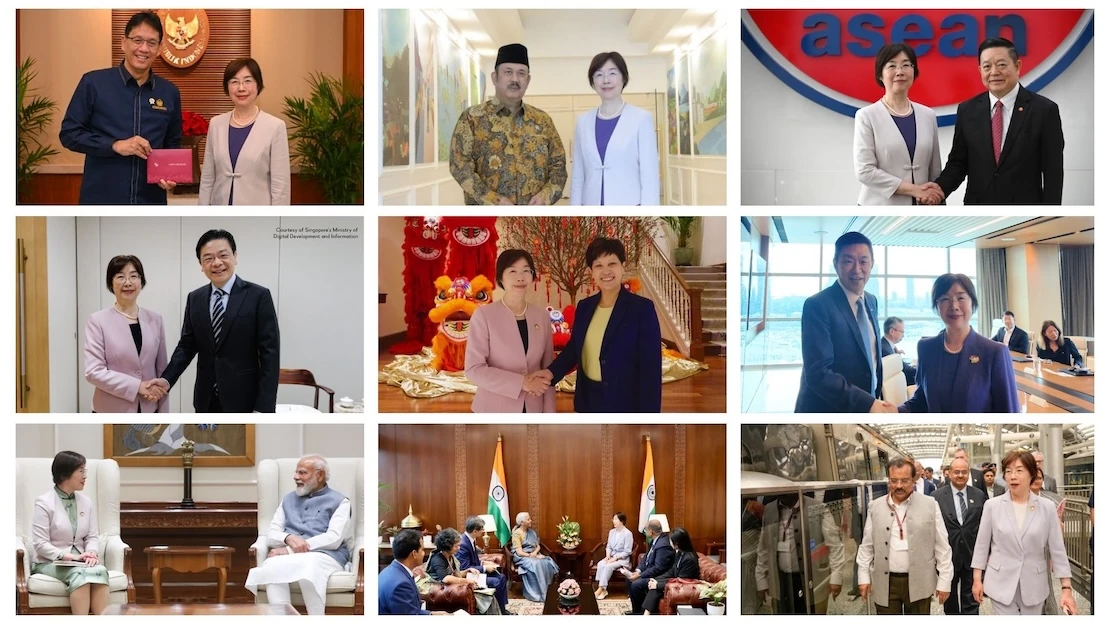
Asian Infrastructure Investment Bank (AIIB) President Zou Jiayi visited founding AIIB members Indonesia, Singapore and India Feb. 24-March 3, underscoring the Bank’s commitment to scaling development impact through strong partnerships, client-centric programming, innovation and private capital mobilization and infrastructure investments.
Part of a “listening tour” Zou is undertaking since assuming office in January, the visits aim to ensure that AIIB’s second decade remains grounded in members’ development priorities and practical delivery on the ground.
Discussions with national leaders, ministers, clients and institutional partners focused on how AIIB can deepen cooperation to address infrastructure gaps, strengthen resilience and expand investment in sustainable development.
In Jakarta, Zou met with the Special Envoy to the President for Climate and Energy Hashim Djojohadikusumo, the Minister of Finance and AIIB Governor Purbaya Yudhi Sadewa and Minister of National Development Planning (Bappenas) Rachmat Pambudy, and other government officials.
They discussed social infrastructure and development priorities across transport networks, power systems and urban development, as well as the country’s energy transition and climate resilience efforts, including nature-based solutions such as mangrove restoration and watershed protection.
They also discussed improving project preparation and implementation capacity. “Financing matters, but delivery begins long before a project reaches approval,” Zou said. “Our goal is to work with clients earlier in the process so that projects are well prepared, implementable and attractive to long-term capital.”
Zou met with Secretary-General of the Association of Southeast Asian Nations (ASEAN) Kao Kim Hourn to reaffirm ASEAN’s role as a key regional partner for AIIB. They highlighted opportunities to scale up financing for sustainable infrastructure, climate resilience, energy transition and regional connectivity, as well as to support key ASEAN initiatives such as the ASEAN Power Grid.
Zou met Minister of Health Budi Gunadi Sadikin and visited a hospital in Jakarta to observe how AIIB-supported investments in medical equipment and facilities can strengthen referral networks and expand access to specialized care.
From Jakarta, Zou traveled to Singapore to meet with Prime Minister Lawrence Wong. Singapore is a key institutional partner in mobilizing capital to meet Asia’s vast infrastructure needs and connecting institutional investors with quality infrastructure projects. “Infrastructure investment requires long-term confidence – in institutions, in rules and in outcomes,” Zou said.
Zou also met with Minister in the Prime Minister’s Office and Second Minister for Finance and National Development and AIIB Governor Indranee Rajah, focusing on Singapore’s role in supporting private capital mobilization, including an ecosystem that makes scale possible.
Zou noted that AIIB’s growing bond issuance and market credibility give it room to expand the ways it connects capital to development, including through standalone operations and co-financed structures.
Zou and Loh Chin Hua, CEO of Keppel, which operates major infrastructure and investment platforms, discussed how private-sector players can help mobilize capital for high-volume, sustainable infrastructure. Their meeting built on the strategic partnership signed last year to mobilize up to USD1.5 billion for infrastructure investments across Asia-Pacific.
She also met with ASEAN+3 Macroeconomic Research Office (AMRO) Director/CEO Yasuto Watanabe to exchange views on the region’s economic priorities and explore ways to strengthen collaboration.
From Singapore, Zou traveled to Delhi to meet with Prime Minister Narendra Modi and the Minister of Finance and AIIB Governor Nirmala Sitharaman to discuss how AIIB can deepen its strategic partnership with India by aligning with national development priorities and co-develop a multiyear rolling pipeline to advance the government’s key infrastructure agendas.
“As AIIB enters its second decade, India, our second-largest shareholder, stands out as a strategic partner not only because of its scale but because of our shared development vision,” Zou said. “India’s long-term infrastructure ambitions align closely with our focus on sustainability, resilience and impact.”
The meetings explored opportunities to expand the deployment of innovative financing instruments that can mobilize private investment, including guarantees, blended finance structures and local-currency solutions.
Zou also traveled to the Delhi-Meerut Regional Rapid Transit System, with trains that can reach 160kph, illustrating how large-scale transport investments can reduce congestion, improve connectivity and expand economic opportunities for local communities. A particular feature is women-only coaches and waiting rooms, as well as facilities for disabled people.