

We usually think of water as something that flows through rivers, reservoirs or underground pipes. But a large share of the world’s water moves in a very different way – it travels through the air, crossing borders, then eventually falls on land as raindrops, nurturing life.
Invisible streams of moisture flow around the planet every day. The amount of water they carry annually is greater than that of the major terrestrial rivers. This is why they are sometimes referred to as “flying rivers.” These flows originate from land and vegetation evapotranspiration, are then carried by wind, and later fall as rain, sometimes thousands of kilometers away. This process is largely quiet and unseen, but it plays a central role in keeping water flowing both at the local and global scales.
The latest AIIB Asian Infrastructure Finance report shows just how shared rainfall really is. On average, only a small part of the rain a country receives comes from water that evaporated within its own borders. Around seven of every 10 drops of rain come from the ocean, while nearly a quarter originates from land abroad. No country or region produces all of its own rainfall.
Each year, about 120,000 cubic kilometers of rain falls on land worldwide. This is an enormous amount – roughly 30 times greater than annual human withdrawals for farming, industry and households. Rain is what refills rivers and groundwater. Without it, most freshwater systems would quickly run dry.
Land ecosystems play a much larger role in generating this rain than is often recognized. Although land covers only about a third of the Earth’s surface, it produces almost half (about 45%) of all rainfall over land. Forests and wetlands are especially important because they store water in soils and plants, then release it back into the atmosphere. This steady supply helps sustain rainfall far beyond their immediate surroundings, over distances ranging from hundreds to thousands of kilometers.
Economies with large areas of forest generate huge amounts of atmospheric moisture that later falls as rain globally. Brazil is the single largest source, producing nearly 8,000 cubic kilometers of atmospheric moisture each year, thanks to the Amazon Forest. This is more water than the Amazon River carries to the ocean annually. Russia ranks second, while China and the United States also make very large contributions. Together, a relatively small group of economies supplies more than half of all rainfall originating from land.
Much of this moisture falls nearby, but not all of it. Some travels long distances. Rainfall occurring thousands of kilometers away can begin its journey in distant forests. Moisture from Brazil, for example, reaches not only neighboring economies, but places as far as New Zealand. Economies with large forests therefore influence rainfall patterns well beyond their borders. Their land‑use decisions matter at a regional and even global scale.
 For many economies, this dependence is more than just a scientific observation. It is a real source of vulnerability. Around 40% of economies receive more than a quarter of their rainfall from foreign land sources. This reliance is especially high for landlocked and inland economies, which cannot draw much moisture directly from the ocean.
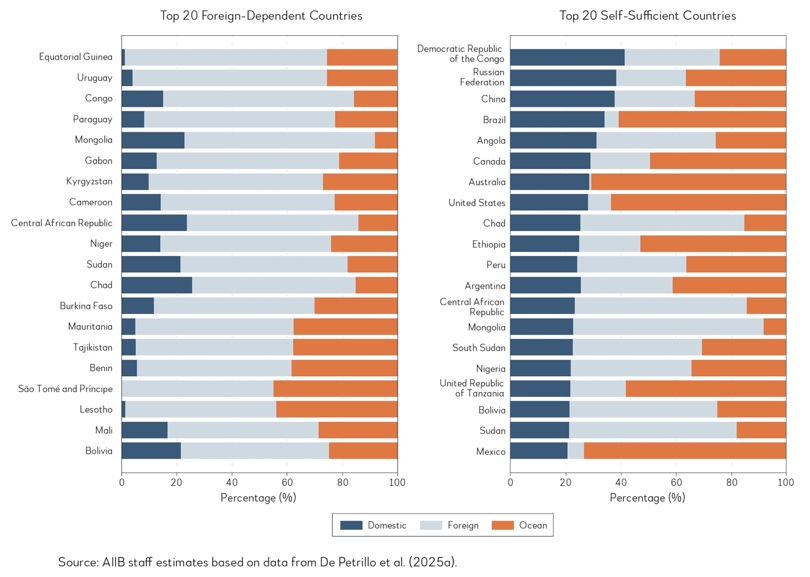
Figure 1: Interdependence of Land Moisture Between Economies
In Central Asia, landlocked economies receive on average more than half of their rainfall from ecosystems outside their borders – more than twice the global average. Similar patterns were observed in parts of Africa. Mongolia, for instance, depends on foreign‑generated moisture for nearly 70% of its rainfall. In these places, water availability is closely linked to land‑use decisions in other economies.
Some economies play a particularly important role in supplying rainfall to entire regions. Russia is the largest external source of rainfall for much of Central and West Asia, while Ethiopia plays a similar role across parts of Africa. These economies effectively act as regional “rain providers.” Changes in their forests, wetlands or land management practices can shape water conditions far downwind.
Forests and wetlands matter more than other landscapes because of how they manage water. They hold it, recycle it, and release it steadily. Farmland and grasslands also contribute moisture, but to a lesser degree. Urban areas, by contrast, tend to reduce the amount of water returned to the air. The type of land cover therefore directly affects how much rain falls elsewhere.
The structure of forests is also important. Large, continuous forests function as strong and reliable “water pumps.” When forests are broken into smaller fragments, they become less effective, even if total forest area remains unchanged. As a result, forest loss or fragmentation can reduce rainfall in distant regions, increasing drought risks and instability.
Flying rivers also reveal an imbalance in who provides water and who benefits. Lower‑income economies, especially in tropical regions, tend to export far more moisture than they receive, while higher‑income economies are usually net receivers. Around 60% of cross-border moisture flows move from lower-income to higher-income economies. Yet the lower-income economies typically receive little recognition to keep this ecosystem service stable.
Both public and private finance could be mobilized to support the conservation of moisture-generating ecosystems. If the water carried through the air were assigned even a modest economic value, the total would reach trillions of dollars each year– far more than current flows of climate or conservation finance. This has important implications for policy and investment. Water security does not depend only on physical infrastructure such as dams, pipes or rivers within a country’s borders, but also on forests and wetlands far away.
Protecting these ecosystems is therefore not just about nature conservation. It is a way of protecting the water supply, reducing climate risk, and supporting economic stability. Economies that benefit from imported rainfall could help finance the protection of these ecosystems through a combination of public and private financial instruments that recognize nature as critical infrastructure. Treating forests and wetlands as a form of natural infrastructure would help align incentives between those who provide water through nature and those who rely on it.
Flying rivers remind us of a simple reality: water connects regions long before it reaches rivers or reservoirs. Rainfall in one place may begin as evaporation in a forest far away. Protecting those forests is not charity. It is a shared investment in long-term water security in an increasingly uncertain climate.
This blog post builds on the findings of Chapter 4, “Flying Rivers,” in the 2026 Asian Infrastructure Finance Report (pp. 31–36). For further details, the full report is available here.
Correction: An earlier version of the blog incorrectly labelled the column 2 in the first table: Top 10 Countries by Total Moisture Contribution as "Precipitation to Other Economies". The table has since been updated with the correct column 2 title as "Global Total Land Precipitation (Billions of Cubic Meters).