

In today's rapidly evolving financial landscape, even emerging institutions can dramatically reshape global markets. This blog delves into the journeys of the Asian Infrastructure Investment Bank (AIIB) and the European Stability Mechanism (ESM). Despite their differences, both have swiftly earned international credibility. Their mutual exchange of expertise, from pioneering digital innovations to refining capital market strategies, underscores a vibrant synergy.
Distinct mandates but shared strong foundations
Though the Asian Infrastructure Investment Bank (AIIB) and the European Stability Mechanism (ESM) differ in mandate, geographic focus, and shareholder composition, both are relatively young institutions that have quickly earned credibility in the global financial system.
AIIB, headquartered in Beijing, began operations in 2016 to meet Asia’s vast and growing infrastructure investment needs. With authorised capital of USD100 billion and a membership that has grown from 57 founding members to 110 approved members globally today, it is a truly international multilateral development bank.
The Luxembourg-based ESM was founded earlier, in 2012, in response to the euro-area sovereign debt crisis. Its mission is to maintain financial stability across the euro area. Backed by about €81 billion in paid-in capital and €627.5 billion in callable capital, the ESM provides financial assistance to its 20 euro area member states through a range of instruments designed to prevent and address financial distress.
Establishing credibility in the capital markets
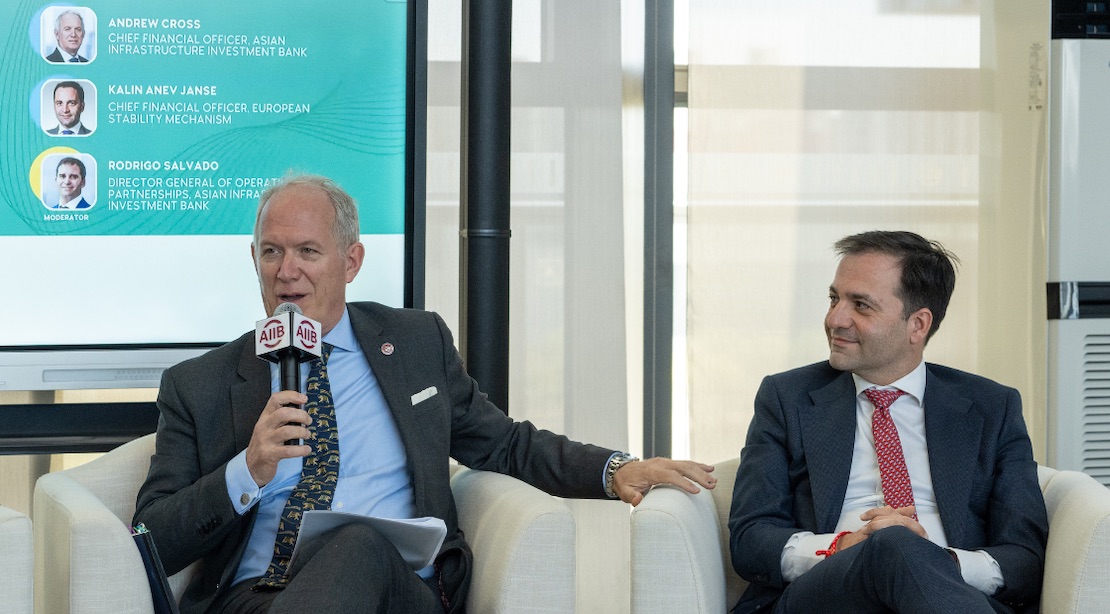
Despite their differing mandates, both institutions have quickly established themselves as prominent participants in the capital markets, each earning and maintaining triple-A credit ratings. They have also embraced innovation by leveraging modern technologies and have strengthened one another through knowledge exchanges to learn from each other’s experiences. This collaboration has been particularly strong at the Chief Financial Officer level. Over the years, the two sides have remained in close contact to discuss challenges, share advice, and support each other through periods of uncertainty.
Mutual support during the Covid-19 pandemic and collaboration in capital markets
When the Covid-19 pandemic crisis struck Europe, the AIIB was weeks ahead operationally, having already migrated to a fully remote set-up. The bank was able to advise colleagues at the ESM on how to run investment portfolios and execute funding activities from outside of the traditional office environment.
This partnership extends to capital markets as well, where both institutions issue bonds in core currencies and manage sizable liquidity portfolios. The ESM invests its capital in safe, highly-rated assets with a strategy aimed at diversifying its investments. This allows the ESM to participate in AIIB’s issuance programme, in which the AIIB issues Sustainable Development Bonds in both US dollars and euros, among other currencies. Similarly, the AIIB’s treasury can purchase ESM bonds as part of its treasury liquidity portfolio.
Leveraging technology as young institutions
On the technology front, there are advantages to being young institutions. Building from the ground up allowed the AIIB and the ESM to integrate the latest technologies without the burden of legacy systems. Exchanges between the institutions allow for the sharing of best technology practices and pitfalls to avoid.
The ESM was an early adopter of cloud infrastructure, a new approach for a multilateral institution at the time. It built an operational model that prioritised value-added tasks and outsourced other activities. After implementing its initial system, the ESM further advanced digitalisation by integrating report, indicator, and analysis production into an internally developed Datahub, significantly improving automation and data visualisation. Treasury data and processes led this transformation, with the overall result proving very stable and able to adapt to the changing needs of the institution.
Adopting shared innovations
Recognising the benefits of the ESM approach to use a cloud-based system coupled with outsourced activities, the AIIB instituted a similar solution that has enabled it to grow its treasury operations while remaining lean on costs and team resources.
Today, both institutions are exploring the benefits of artificial intelligence. Each has recently deployed Microsoft Copilot across their teams and is developing robust governance frameworks to promote responsible use. The aim is to boost productivity while safeguarding data, integrity, and institutional trust.
A sustained partnership which can help shape global finance
The continued exchanges between the AIIB and the ESM, whether on funding operations, technology adoption, or policy development, represent the sustained and pragmatic partnership envisioned in the memorandum of understanding signed between the two institutions. Moreover, AIIB and the ESM are proof that even the newest players can help shape global finance.