
Current global challenges, including the recent COVID-19 pandemic along with geopolitical tensions and the threat of climate change, call for multilateral development banks (MDBs) to “evolve” their operating models to achieve long-term development impact.
Although established not more than eight years ago, and thus relatively “younger” than other MDBs, the Asian Infrastructure Investment Bank (AIIB) has demonstrated a commitment to high standards—as well as strong governance and accountability—owing to its innovative operating model.
The innovations built into AIIB’s governance allow the Bank to remain lean and efficient, with its nonresident Board of Directors able to focus on strategy and policy issues and results monitoring, while Management remains accountable for the Bank’s decisions.
AIIB has taken important steps to enhance the efficiency and integrity of its governance, with the aim of allowing the Bank’s Board of Directors to focus more on guiding the strategic direction of the institution.
“In our decision-making, we are a very consensus-oriented bank. The Bank does not have majority ownership by advanced countries and no group of countries dominates decision-making,” says Ludger Schuknecht, Vice President and Corporate Secretary of AIIB, pointing out that while China is the Bank’s biggest shareholder, advanced countries (mostly from Europe) have a 25-30 percent share and emerging markets from Asia have about 50 percent.
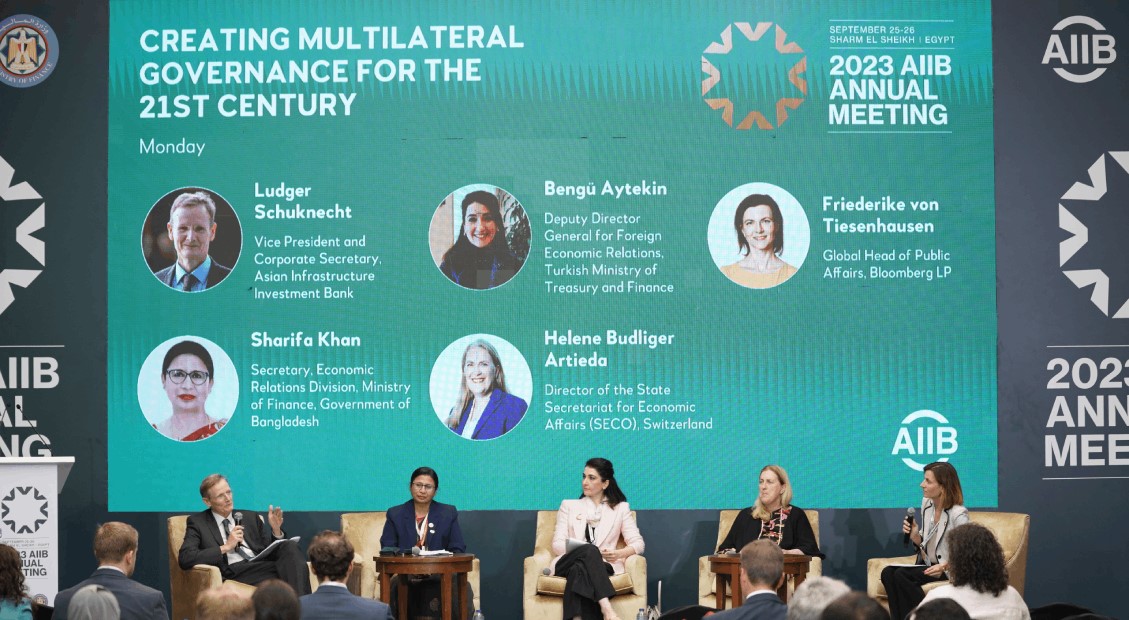
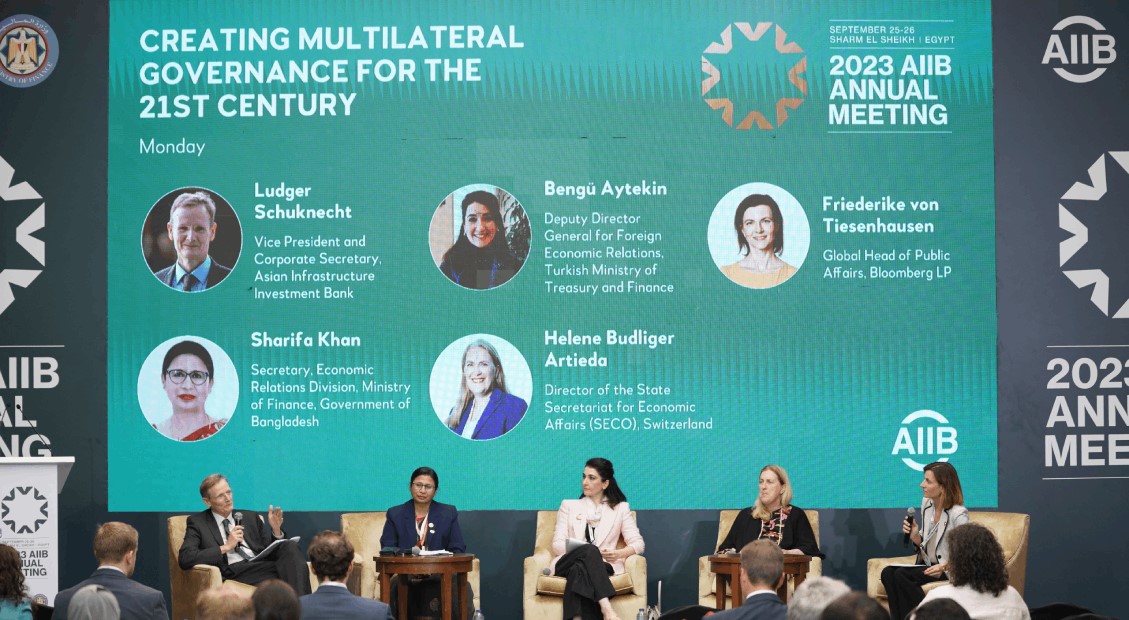
The 75-percent ownership consensus holds for important strategy and policy decisions, according to Schuknecht, who was among the panelists in the session titled “Creating Multilateral Governance for the 21st Century” at the 2023 AIIB Annual Meeting in Sharm El Sheik, Egypt.
Beyond strong governance and an innovative ownership model, the session also discussed how AIIB can continue pursuing innovation as an MDB to serve its Members better, particularly least developed countries and those in emerging markets.
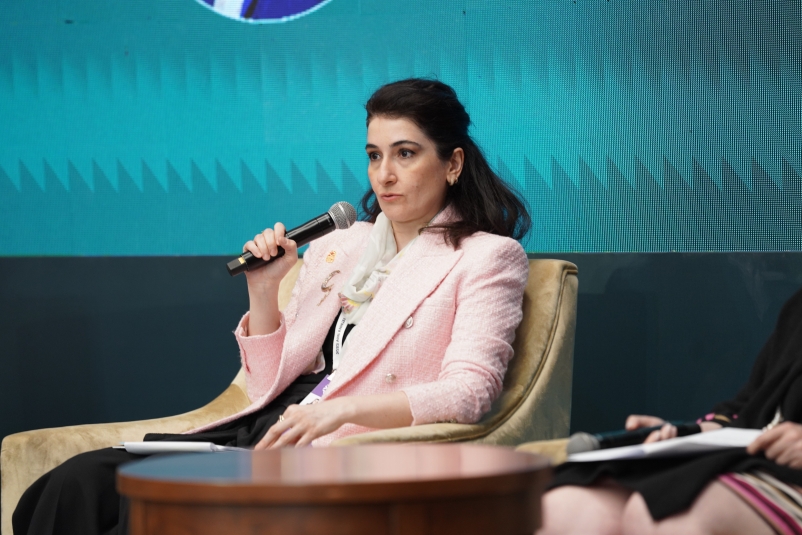
“MDBs have the potential scale, reach, knowledge and tools to play a bigger role in confronting these global challenges. MDBs must incorporate these new realities in their business models,” says Bengü Aytekin, Deputy Director General for Foreign Economic Relations, Ministry of Treasury and Finance, Türkiye.
Aytekin points out AIIB’s practical approach to combining investment and capacity building as one of its strengths as a global financing institution.
“It has a focus on complementing and mobilizing private sector finance. And it has the ability to work with both private and public sectors,” Aytekin said. “With these attributes, the Bank has proven itself relevant since its establishment.”
At the same time, the current global landscape call for cooperation and coordination among MDBs.
“We’re all dealing with scarce resources, so coordination among MDBs down to the country level and cross-border connectivity should be welcome on our side (as shareholders),” says Helene Artieda, Director, State Secretariat for Economic Affairs, Switzerland.
For its part, AIIB has been working with partner MDBs, particularly in cofinancing.
“We still have quite some room to lend to our client countries. Our partner MDBs are much more constrained with some countries. We can help to finance in other countries where other MDBs have less space,” says Schuknecht.
Although younger than other MDBs, AIIB has been recognized for its work in emerging sectors, particularly green financing. Investments in climate-resilient infrastructure is important for least developed countries such as Bangladesh.
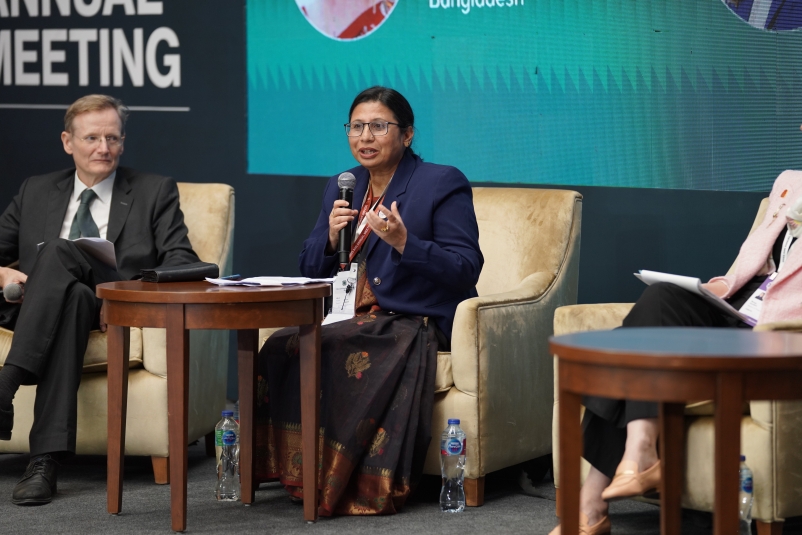
“There is a huge financing gap and AIIB can play an active role in addressing this issue,” says Sharifa Khan, Secretary, Economic Relations Division, Ministry of Finance, Government of Bangladesh.
Asked how AIIB can address geopolitical tensions, Schuknecht acknowledges that this is a risk that AIIB has to “maneuver” with, but remains optimistic of the Bank’s strong governance model.
“Our governance is good because says we are apolitical; we cannot support or favor one country or group more than others,” says Schuknecht. “We are held accountable to it by our stakeholders. That’s not something you demonstrate with one project. But that’s something you have to demonstrate over time.”
Aytekin, meanwhile, encourages AIIB to increase efforts to expand on innovative financing products, such as green bonds and infrastructure asset-backed securities. She added AIIB’s business model must be increasingly relevant to the global development context.
“To enhance its impact, it is essential for AIIB to use its capital as fully as possible and maintain a diversified and fully sustainable portfolio. Continuous private capital mobilization will be important,” Aytekin says.
Watch the session replay on the AIIB YouTube channel.