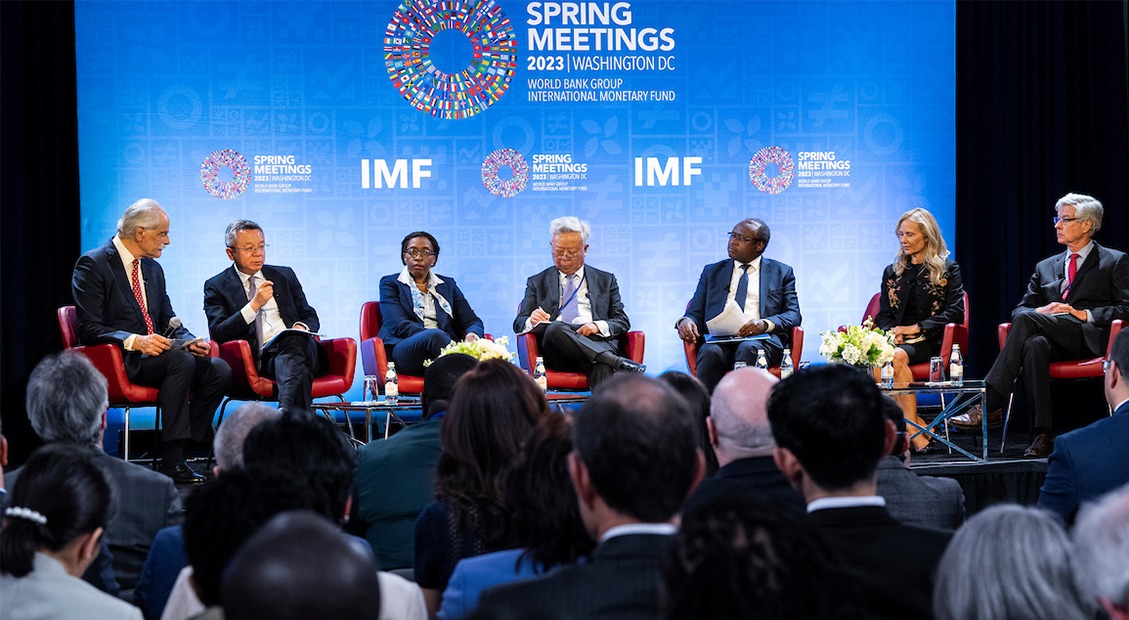

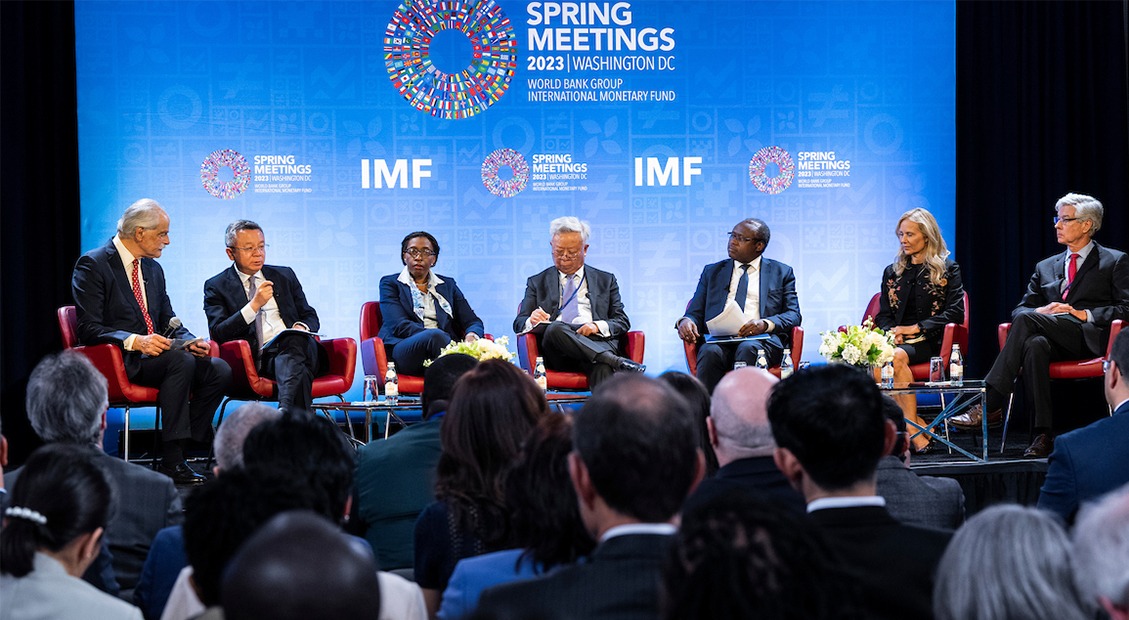
Asian Infrastructure Investment Bank (AIIB) President Jin Liqun just wrapped up a week of engagements with global leaders, the private sector, development partners and civil society organizations on the sidelines of the 2023 Spring Meetings of the World Bank Group and International Monetary Fund (IMF) in Washington D.C. Deepening and broadening international partnerships to tackle pressing global challenges was top of his mind, as well as concerted action to address the climate crisis in line AIIB’s own climate agenda.
Highlights
- In a keynote speech on MDB Responses in the Polycrisis Era at the Rockefeller Foundation, President Jin called for an “institutionalized forum for multilateral development banks (MDBs) and other international financial institutions to discuss progress and actions on climate finance.” He added, “If humanity’s moonshot to net-zero is to be successful, then coordination and collaboration in climate finance is mission critical.” Read President Jin’s full speech here.
- In a dialogue with Sri Mulyani Indrawati, Minister of Finance of Indonesia, President Jin highlighted that “MICs urgently need significant amounts of capital and technical expertise.” He also noted that MDBs and development partners should spend more time working with middle-income countries (MICs) to collaboratively design multiple-year investment programs with a focus on transformational projects that are truly country-driven. The dialogue was organized by the Center for Global Development.
- Speaking about the G20 Capital Adequacy Framework review process, President Jin stressed that while AIIB is adequately capitalized, “We are taking to the heart the recommendations of the G20 Capital Adequacy Framework report and actively engaging our Board on their implications and our progress in implementing them.”
- At the regular meeting with Heads of peer MDBs, President Jin emphasized that country sector platform approaches present a promising and practical solution to amplify the effectiveness and efficiency of MDBs and should be developed actively for the purpose of COP28. On the relevant issue of dealing with increasing debt burden in developing countries, he emphasized that “AIIB is looking to provide a broader suite of financing instruments that consider debt burdens and revisit the risk appetite of our climate financing as per the UNFCCC COP27 decision. This includes a more active and expanded use of guarantees, and portfolio swaps with other MDBs to improve our average credit rating and allow for more exposure in lower-rated Members.”
- In meetings with Antonio Guterres, UN Secretary-General, and Amina J. Mohammed, UN Deputy Secretary-General, President Jin expressed AIIB’s willingness to establish strategic, fruitful partnerships with the UN on mutually aligned goals, particularly climate. President Jin also highlighted that “The international community must collectively implement the needed changes, while countries should put in place national policies to better align all financing flows with the SDGs, such as through Integrated National Financing Frameworks (INFFs).”
- During a discussion in New York, President Jin and Michael Bloomberg, founder of Bloomberg L.P. and Bloomberg Philanthropies in New York, discussed the idea of co-creating a new investment collaboration mechanism, with a focus on scaling up renewables in emerging markets. The focus, he said, will be on mobilizing private capital and attracting Asia-based Sovereign Wealth Funds.
The AIIB delegation was led by President Jin Liqun, together with Vice President for Policy and Strategy Sir Danny Alexander; Andrew Cross, Chief Financial Officer; and Erik Berglöf, Chief Economist.