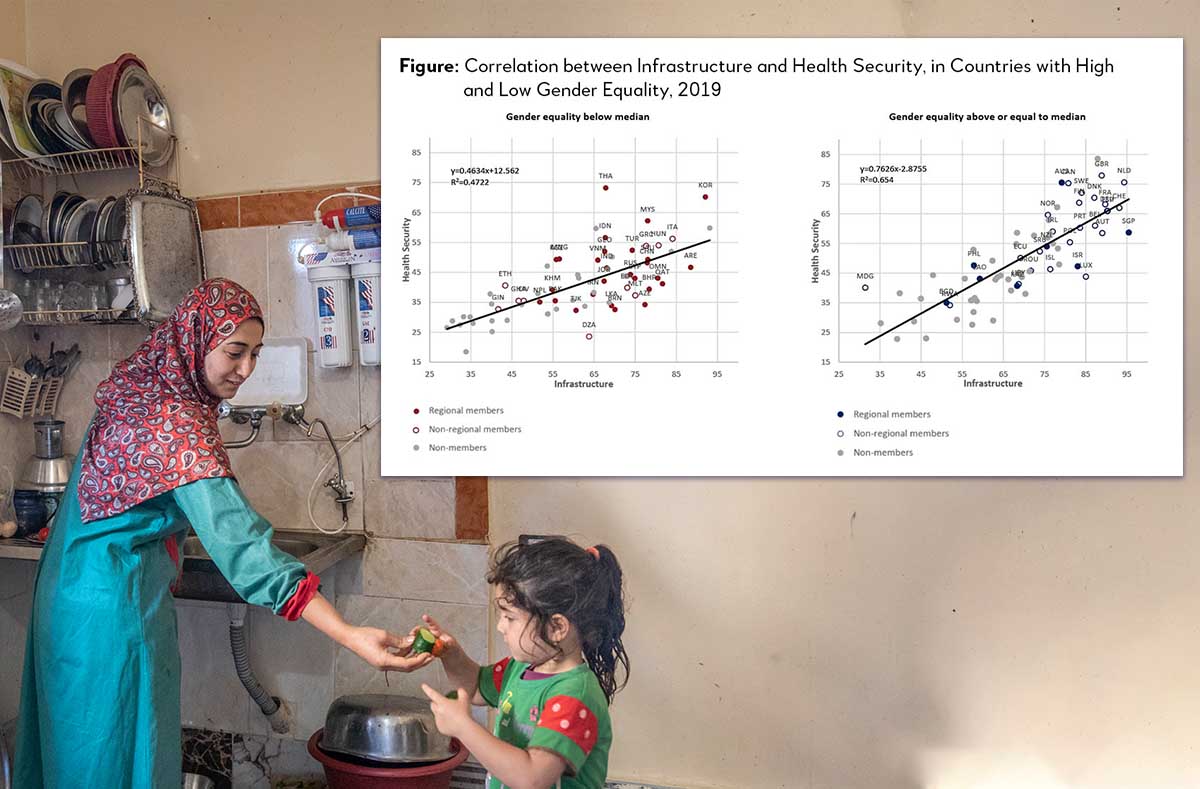

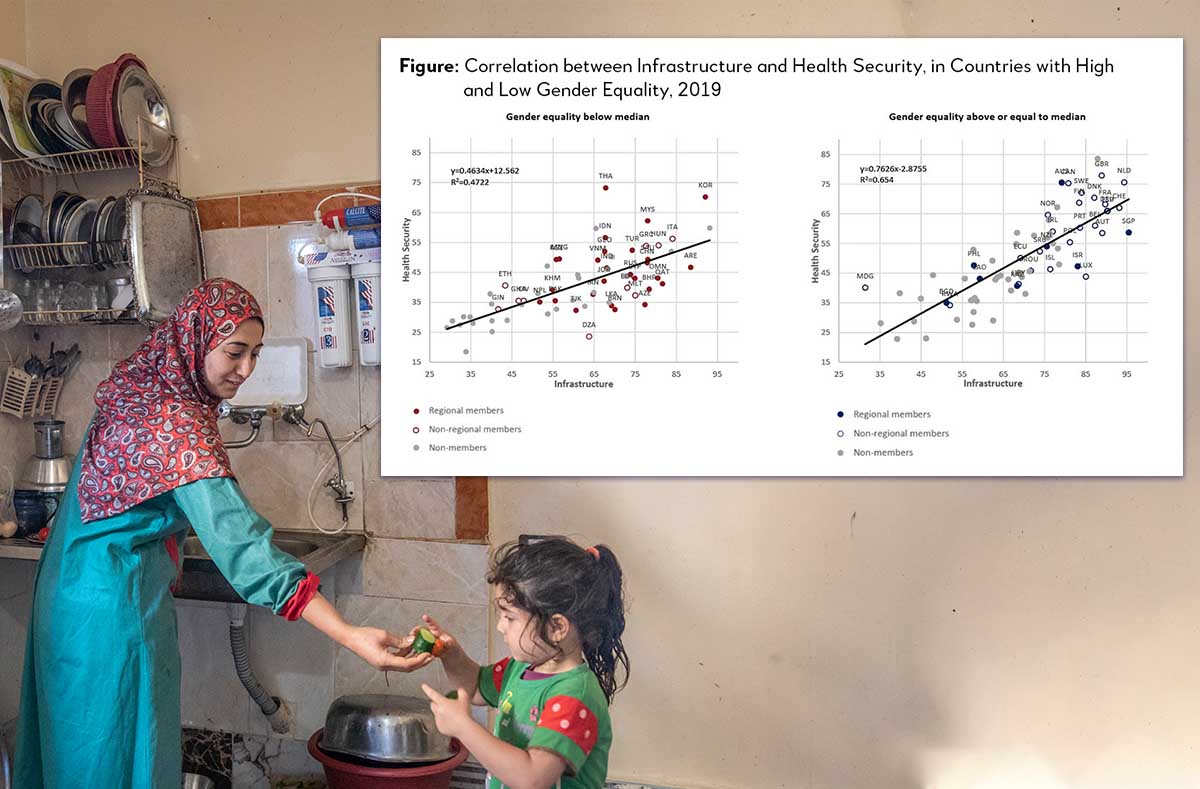
As we have seen, the impacts of the COVID-19 pandemic are not gender-neutral, with the majority of frontline health and care workers being women and the increase in gender-based violence. In fact, the experience from other crises in the late 2000s—such as the Great Recession and Ebola—shows that gender inequalities widen during periods of economic turmoil.1 Policymakers have identified a range of important short-term and long-term solutions.2 While governments are rightly focused on short-term survival, it is important not to lose sight of the bigger picture, and the policies that can sustain health security in the longer term. More precisely, in this note, we want to highlight the linkages between infrastructure, health security and gender equality.
Recent research3 by the Asian Infrastructure Investment Bank (AIIB) argues that once the immediate task of containing COVID-19 has been achieved, the focus will need to shift from crisis management to assist developing economies invest in adequate infrastructure for development, as well as to prevent and mitigate the impact of future outbreaks. Significantly, this work shows that a country’s readiness to cope with epidemics is correlated with the quality of its infrastructure, and that infrastructure development is a key part of health security and epidemic preparedness.
Building on this work, the Figure examines the correlation between general infrastructure (e.g., capturing roads, rail transport, air transport, sea transport, electricity, and water infrastructure) and health security, by levels of gender equality. While the correlation in both cases is positive, it is stronger in countries with high gender equality, as compared to countries with low gender equality. In other words, in countries with higher gender equality, investments in infrastructure may have a greater impact on improving health security. The difference is statistically significant and economically meaningful and is not explained away by the fact that richer countries may just have better infrastructure, health security and gender equality. According to the Figure, an improvement in infrastructure from the level of that in Bangladesh (51.1) to that of Azerbaijan (77.4) would improve health security by 12.2 points (on a 0-100 scale) in a country with low gender equality. In contrast, in a country with high gender equality, the improvement would be 20.0 points.
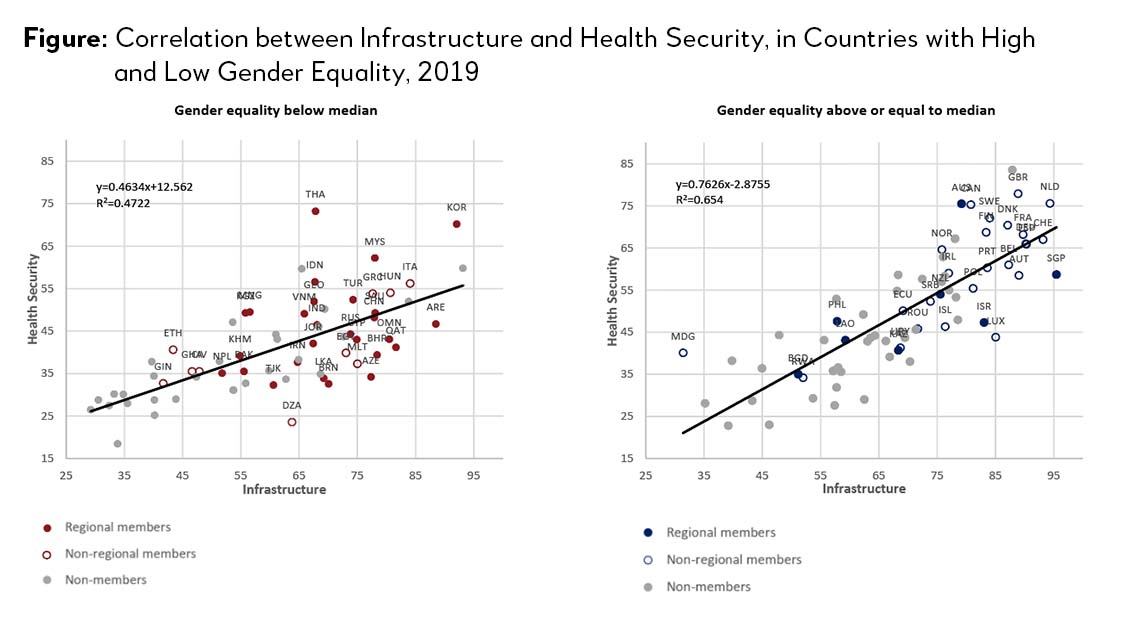
Notes: Infrastructure is on a scale of 0 (worst)-100 (best) and is from the Global Competitiveness Report 2019. It includes the following subindicators: road connectivity, quality of road infrastructure, railroad density, efficiency of train services, airport connectivity, efficiency of air transport services, liner shipping connectivity, efficiency of seaport services, electricity access, electricity supply quality, exposure to unsafe drinking water, and reliability of water supply.
Health security is on a scale of 0 (worst)-100 (best) and is from the Global Health Security Index Report 2019.
Gender equality is from the WEF Global Gender Gap Report 2020, which combines gender gaps in four sub-indices: (1) economic participation and opportunity; (2) educational attainment; (3) health and survival and (4) political empowerment. The highest possible score is 1 (equality) and the lowest possible score is 0 (inequality). The three-letter codes in the figure refer to the ISO code for countries/regions in the world, available at https://www.iso.org/iso-3166-country-codes.html. The membership status of AIIB members is available at https://www.aiib.org/en/about-aiib/governance/members-of-bank/index.html.
What can explain the correlations identified in the Figure? Unfortunately, the data do not allow us to disentangle the precise mechanisms, but we can offer a few conjectures. In countries with higher gender equality, transportation is likely to be more gender-friendly, meaning that women may be better able to access it for health emergencies. Similarly, water infrastructure that works for women is likely to be of a standard or quality that will serve better at preventing water-borne diseases. Countries with higher gender equality will also have higher rates of female education, meaning that women may be more knowledgeable about the detrimental effects of unsafe water, or when and how they should attend a hospital in the event they or other members of their family are unwell.
The Figure shows clearly that investments in infrastructure are positively correlated with health security, but it also shows that such improvements are likely to have the highest impact on health security in countries where there are higher levels of gender equality.
Designing and operating infrastructure is part of the complex matrix of actions and policies needed to improve health security. Understanding that these investments have even greater impact in an environment of high gender equality should act as an incentive for both the public and private sector to ensure, at a minimum, that the infrastructure financed takes into account how men and women use and benefit from infrastructure differently. It would seem, therefore, that investing in gender-friendly infrastructure is essential for paving the way to both gender equality and sustainable health. Such policies are all the more relevant now, in the midst of the COVID-19 pandemic, which will undoubtedly exacerbate gender inequalities around the world.
1 United Nations. 2020. Policy Brief: The Impact of COVID-19 on Women. (April 9). https://www.un.org/sites/un2.un.org/files/policy_brief_on_covid_impact_on_women_9_apr_2020_updated.pdf.
2 The World Bank. 2020. Policy Note: Gender Dimensions of the COVID-19 Pandemic. (April 16). http://documents.worldbank.org/curated/en/618731587147227244/pdf/Gender-Dimensions-of-the-COVID-19-Pandemic.pdf.
3 Asian Infrastructure Investment Bank. 2020. Impact of the Coronavirus (COVID-19) and Its Implications for Infrastructure Priorities. (March 25). https://www.aiib.org/en/news-events/news/2020/_download/Background-Impact-of-Covid-19-and-Implications-on-Infrastructure-Priorities.pdf.