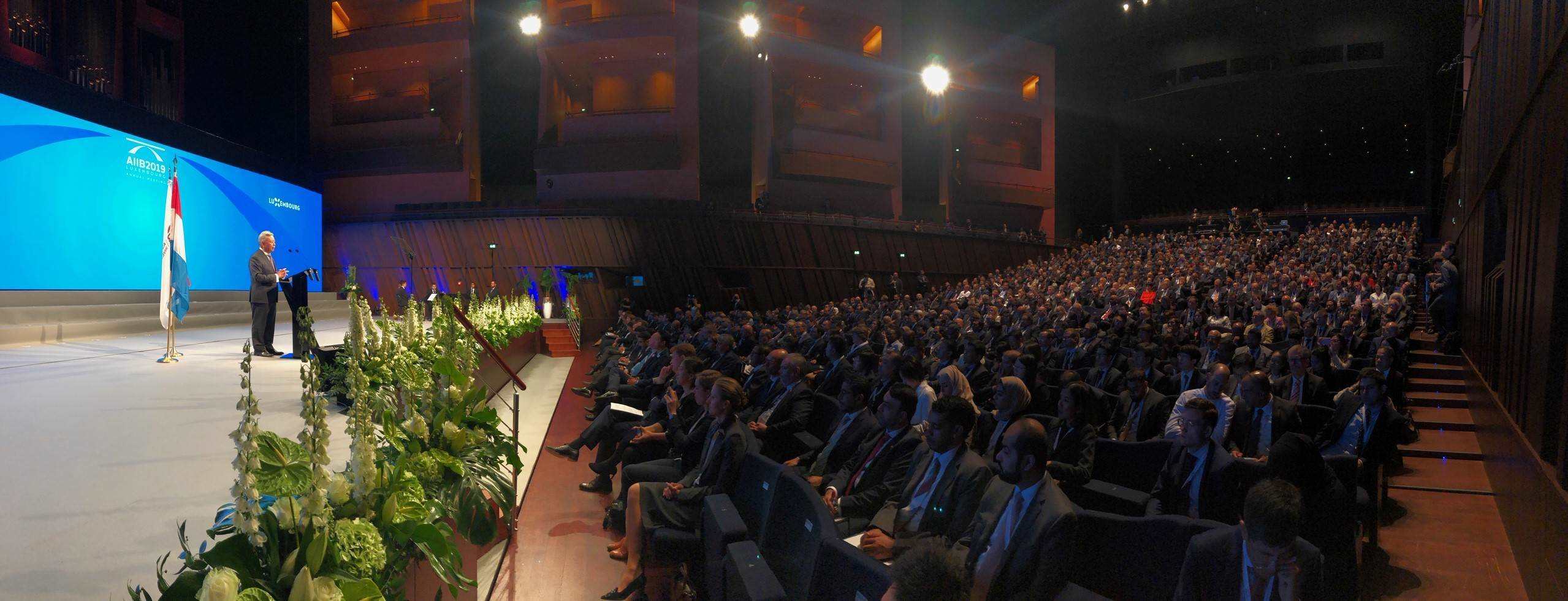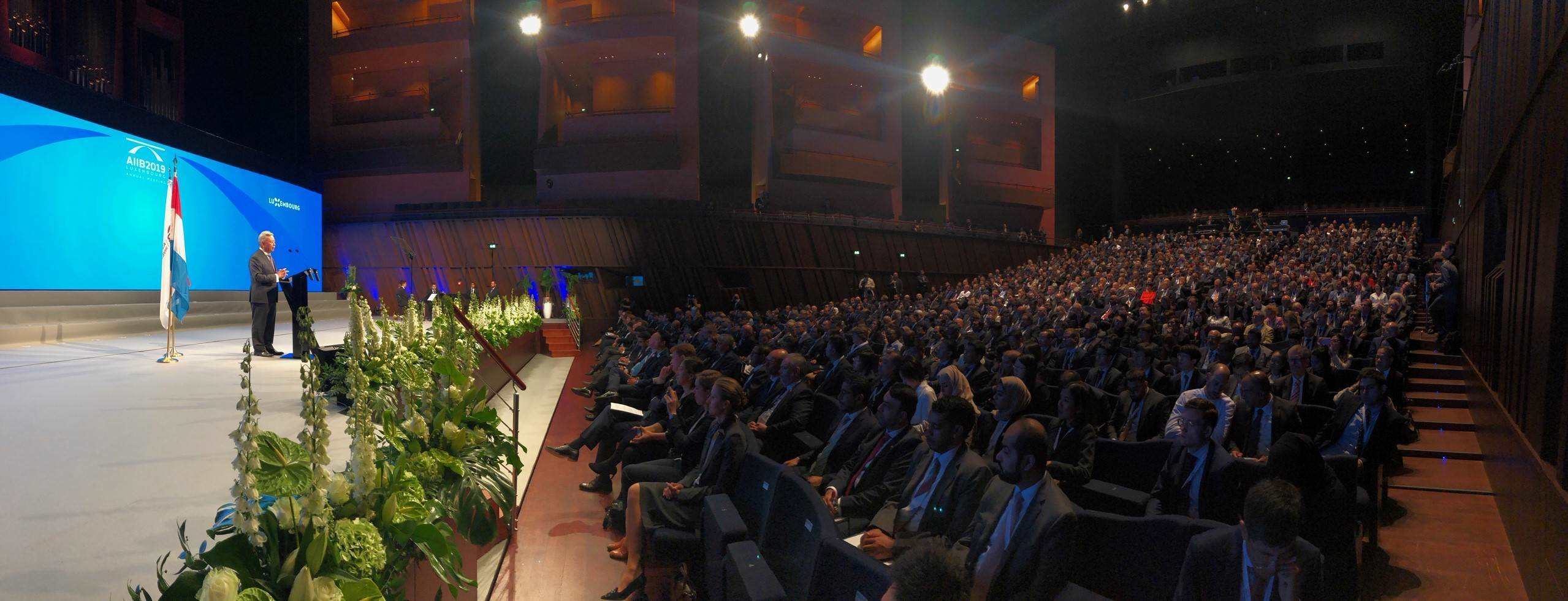
The Philharmonie Luxembourg in Kirchberg hosts about 400 performances every year and is one of Europe’s premier concert venues. It seats up to 1,500 listeners and was designed for optimal acoustics and public involvement—with a stage visible from all sides, like in Shakespearian theater.
This morning, the Philharmonie’s audience did not come for Shakespeare nor music. Instead they were much ado about infrastructure and listened to a symphony of suggestions on how harmony among regional sustainable development efforts could be achieved in concert.
On center stage were His Royal Highness Henri, Grand Duke of Luxembourg; Luxembourg Prime Minister Xavier Bettel; Luxembourg Finance Minister Pierre Gramegna; Singapore’s Indranee Raja representing an AIIB governorship from Asia; Egypt’s Finance Minister Mohamed Maait representing an AIIB governorship from outside Asia and Asian Infrastructure Investment Bank (AIIB) President Jin Liqun.
Luxembourg became the first European country to sign as a founding member of AIIB and is this year’s host of the 2019 AIIB Annual Meeting—the Bank’s first outside Asia. Prime Minister Bettel said that a few years ago, he was faced with a difficult decision: To join or not to join AIIB? That was the Shakespearean question.
“It was not the easiest of decisions,” he said. “Some colleagues said ‘don’t do it.’ My country was not always the rich country it is today. It was a poor country, but we were able to become the first mover because we believed in these things, we wanted to do things. We believed in this common project (AIIB). We believe in being open, being ready to take challenges together. We respect—and if all the world would have this same respect, then everything would be easier. We believe in change, we believe in bridges, we believe that no one can resolve common problems by themselves.”
With regard to climate change and green and sustainable development, Prime Minister Bettel said: “Economy and ecology are not enemies as long as we are able to do it at the right time and in the right direction.”
Luxembourg Finance Minister Pierre Gramegna also issued the call to cooperate for us to address the sustainable development goals together and with the help of private capital.
“We need to crowd in private capital,” he said. “Public money can trigger the guarantees, but we need the private sector. President Jin Liqun was the right choice as AIIB President, and this was a courageous decision. He built mutual trust from shareholders all over the word.”
Later in his speech, President Jin said: “Finance Minister Gramegna, I recall our conversation on the creation of AIIB. You were clear-cut in your position: What AIIB should be. What it shouldn’t be. What AIIB should and shouldn’t do. I’m sure your ideas about the identity and behavior of the proposed bank represented the opinion and sentiment of Luxembourg and its people.”
His Royal Highness Henri, Grand Duke of Luxembourg acknowledged the role of multilaterals like AIIB in addressing global challenges.
“In times of uncertainties, IFIs such as AIIB are key, especially during times of climate change and when human lives are under threat around the world,” said the Grand Duke. “The infrastructure of tomorrow must improve the quality of life of millions of people through sustainable solutions.”
Toward the end of his address, President Jin stressed his belief in Asia, in cooperation and in connectivity. “I am heartened by your presence here in Luxembourg because I have seen the power of collaboration in action,” he said. “Yet, we have only just begun. I believe the future for Asia is bright. With your help, we have become the Bank striving for connectivity in Asia. With your help, we will become the Bank that connects Asia to the world.”
Beijing, August 18, 2026
Building Nature into Infrastructure: Turning Biodiversity Commitments into Better Investments
The triple planetary crisis of climate change, biodiversity loss and pollution poses a growing threat to the environment and the economy. Actions are needed to halt and reverse biodiversity loss while advancing sustainable development. As countries implement the Kunming-Montreal Global Biodiversity Framework through their National Biodiversity Strategies and Action Plans, attention is increasingly turning from commitments to implementation. For AIIB, this means identifying practical ways to integrate biodiversity considerations and nature-based solutions (NbS) into infrastructure investments that deliver lasting economic, environmental and social benefits.
READ MOREBeijing, August 14, 2026
Financing Infrastructure for Tomorrow Through a Broader Sustainability Lens
Climate has rightly been central to the conversation around sustainable infrastructure for much of the past decade. However, infrastructure performance is also shaped by interconnected environmental and social factors. AIIB’s 2025 Sustainability Report reflects this broader lens, showing how these factors can affect long-term asset and portfolio performance.
READ MOREBeijing, August 13, 2026
How Technology Enhances the Development Impact of Infrastructure
At a busy urban crossroads, infrastructure is easy to see. Cars move through lanes. Buses stop and start. Pedestrians wait at crossings. Traffic lights guide the flow of movement through the city.
READ MOREBeijing, August 10, 2026
Our Most Diverse Class Yet: Highlights from the 2026 Global Internship Program
Our Global Internship Program just had its biggest year. We received 14,352 applications from 158 economies for 38 internship positions – our largest applicant pool since the program launched in 2018, and a clear sign that interest in AIIB’s Young Talent Programs keeps growing.
READ MORE