

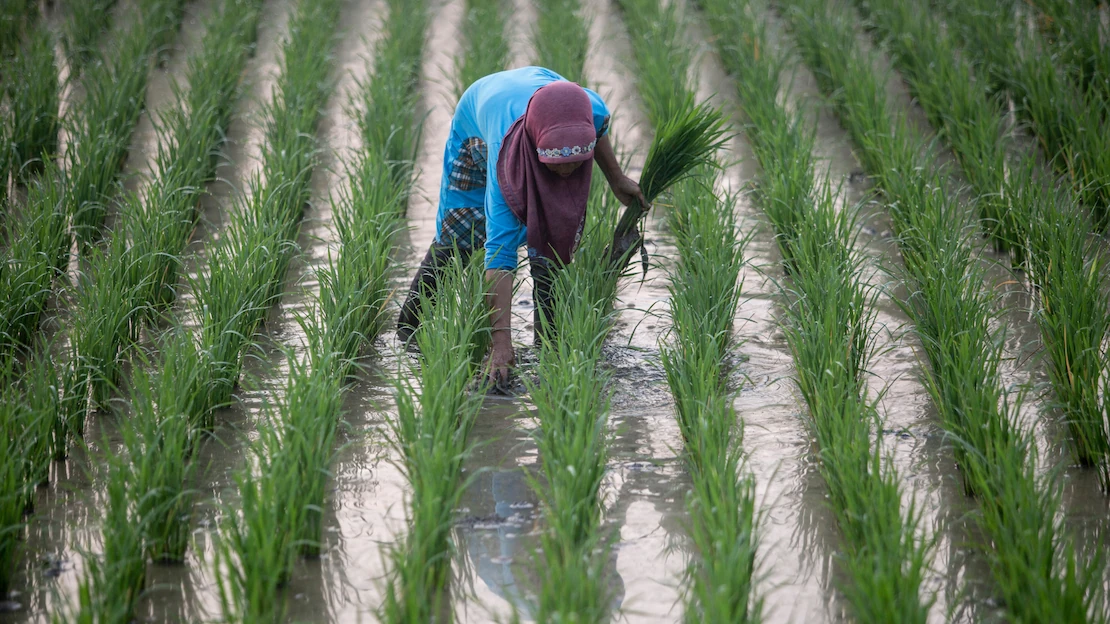
Irrigation systems are critical to rural economies such as Indonesia’s. They underpin food production, climate resilience and rural livelihoods.
Yet much of the country’s irrigation infrastructure is aging. Sedimentation is widespread and water delivery is often unreliable. Competition from urban and industrial water users further strains supply in major river basins. Recognizing these constraints, the Government of Indonesia, with financing from the World Bank and the Asian Infrastructure Investment Bank (AIIB), implemented a major project to rehabilitate and modernize irrigation systems across the country.
A rigorous impact evaluation of the Strategic Irrigation Modernization and Urgent Rehabilitation Project (SIMURP), as it is formally known, reveals that irrigation rehabilitation generally boosts farm profitability. However, its impact varies significantly across agroecological zones. Understanding where and why these impacts differ offers valuable lessons for irrigation policy in Indonesia and the wider region.
Agriculture plays a central role in Indonesia. Between 2014 and 2023, the sector contributed an average of 13.1% to national GDP while absorbing 28.2% of the labor force (BPS Indonesia, 2025). It remains the primary source of employment for poor households, with 64% of Indonesia’s poor working in agriculture. This underscores the sector’s importance, particularly in rural areas, where livelihoods are highly vulnerable to climate- and water-related shocks.
Irrigation stabilizes crop production, sustains cultivation during dry periods and enhances the productivity of complementary inputs such as fertilizer and labor. All this is increasingly important as climate volatility intensifies in Indonesia, with more frequent drought cycles, irregular rainfall and watershed degradation. Of 7.4 million hectares of irrigated land, roughly half require rehabilitation, resulting in efficiency losses in irrigation water services and foregone value added.
As part of the national plan, the irrigation project supports the upgrading of canals, intakes and control structures, and distribution networks across 276,000 hectares, serving about 880,000 households. The project’s geographic diversity allows for a unique assessment of how irrigation infrastructure performs across distinct water and climate contexts.
Survey data collected in 2025 from 2,318 households reveal marked differences in cropping patterns, yields and production constraints across three regions where the project was implemented.
West Java: High Potential, High Returns
West Java’s Jatiluhur Irrigation Scheme is highly productive but increasingly constrained by aging infrastructure, sedimentation and rising urban and industrial water demand. Irrigation rehabilitation under the project led to substantial gains, with the net value of agricultural production more than doubling during the dry season. Improvements occurred along both the extensive and intensive margins: previously fallowed plots were brought back into production, while rice yields increased by about 25%, driven by more reliable water delivery and lower labor and input costs.
These gains translated into the highest economic returns among the three regions, with an estimated economic internal rate of return (EIRR) of 31%. This highlights the high payoff of rehabilitation in agroecologically favorable settings, where infrastructure constraints, rather than natural conditions, are the primary bottleneck to productivity.
South Sumatra: Expanding Cultivation Under Biophysical Constraints
South Sumatra’s Karang Agung Hilir relies on tidal irrigation, where rice production is constrained by soil salinity and seasonal freshwater availability. Following rehabilitation under the project, agricultural production increased by about 35%, with gains concentrated during the rainy season. The gains were driven primarily by the expansion of cultivated area, as better water management enabled farmers to bring more land into production when freshwater conditions were favorable. However, yields per hectare showed limited improvement, reflecting the continued influence of salinity and other biophysical constraints.
Despite these limitations, the project achieved a robust EIRR of 29% in the region. This suggests that expanding cultivated area can generate substantial returns even when productivity per hectare is constrained, though the scope for further gains may depend on addressing underlying environmental and agronomic challenges.
Nusa Tenggara: Intensive Gains in Water-Constrained Systems
In Nusa Tenggara, the Jurang Sate/Batu systems operate under chronic water scarcity in a highly variable, semi‑arid climate, with very small farm sizes averaging 0.35 hectares. Irrigation rehabilitation led to production gains of about 24%, primarily during the rainy season. These gains were largely intensive, arising from higher yields and reduced production costs rather than expansion of cultivated area. Continued dry-season water scarcity limited the scope for increasing cropping intensity or bringing additional land into production.
Reflecting these structural constraints, the estimated EIRR was considerably lower than in the other areas, at around 7%. This suggests that while irrigation improvements can enhance efficiency in water-scarce environments, overall returns on investments are closely tied to underlying hydrological conditions.
Higher Farm Profits Do Not Automatically Improve Household Nutrition
In Indonesia, where stunting affects over 20% of children and micronutrient deficiencies remain widespread, understanding the relationship between agricultural infrastructure investments and household nutrition is important. Despite significant increases in agricultural profitability, the study found no meaningful changes in dietary quality among project beneficiary households. This is consistent with global evidence showing that greater staple crop production does not automatically translate into improved diets.
By linking irrigation investments to nutrition objectives through measures such as crop diversification, kitchen gardens and improved access to nutrient-rich foods, infrastructure projects can deliver dual benefits: food security and better health outcomes. Cross-sectoral collaboration across infrastructure, agriculture and health departments is therefore essential to achieving greater benefits of investment.
Recommendations
Several policy-relevant recommendations emerge from the analysis.
First, irrigation investments should be tailored to local agroecological conditions. Irrigation rehabilitation can be scaled up in high‑potential areas such as Jatiluhur, but only with improved water governance to avoid unsustainable reservoir withdrawals. In regions facing ecological constraints, irrigation investments should be complemented with appropriate small-scale and decentralized water infrastructure, such as water storage tanks, on-farm reservoirs and conveyance improvements, alongside strategies that extend beyond infrastructure alone.
Second, complementary interventions should be strengthened through coordinated, multi-sectoral action. Where dry-season irrigation potential is limited, productivity and resilience gains depend on integrated interventions including drought- and salinity-tolerant crop varieties and diversified rural livelihoods. Delivering these measures requires close coordination beyond the Ministry of Public Works, particularly with the Ministry of Agriculture and other relevant government agencies, to support farm-level adoption, input access, extension services and climate information.
Finally, irrigation and agricultural investments should be complemented with nutrition-sensitive programming. Irrigation investments alone may not be sufficient to improve diets and nutritional outcomes. Parallel efforts to promote crop diversification, support horticulture and livestock production and strengthen nutrition education are essential to translating productivity gains into improved household welfare and nutrition outcomes.
This blog post builds on the findings of Chapter 5, “Strengthening Water Infrastructure for Resilient Agriculture,” in the 2026 Asian Infrastructure Finance Report (pp. 39–48). For further details about the study, please see AIIB Working Paper 21: Irrigation Rehabilitation and Farm Economic Outcomes: Evidence from Diverse Agroecological Typologies in Indonesia.