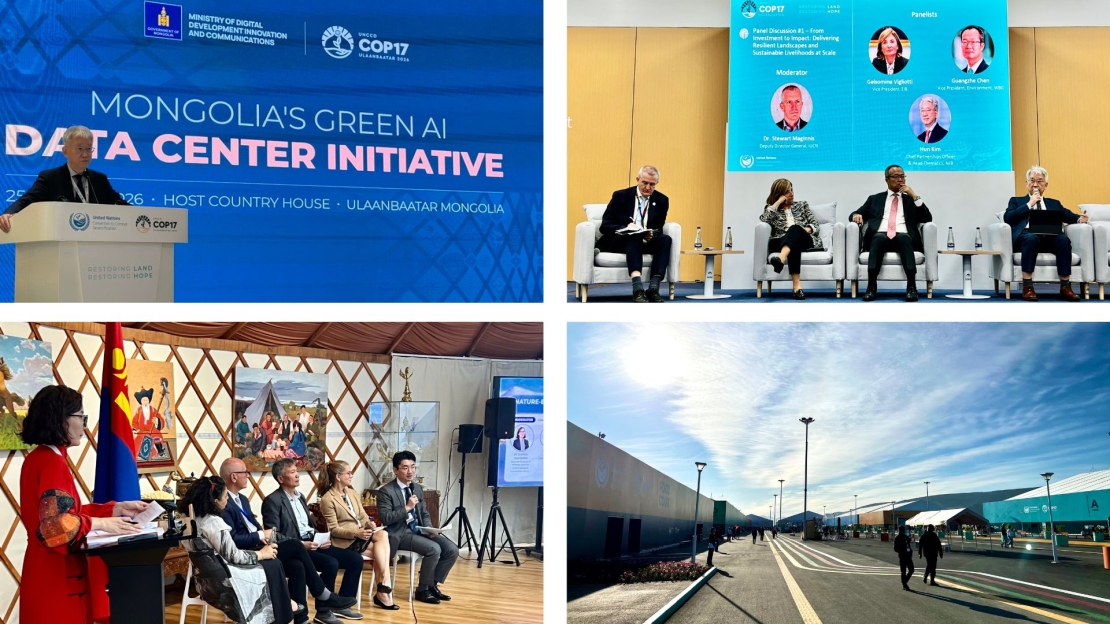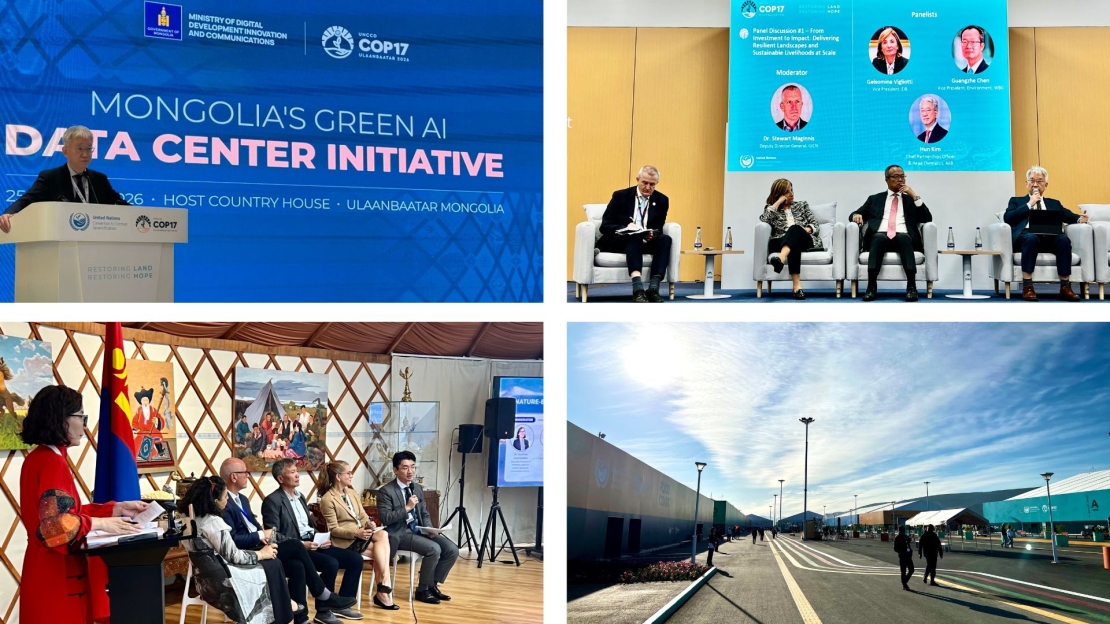
Land degradation and drought resilience are increasingly relevant to how infrastructure is planned, financed and delivered, particularly in dryland economies. The 17th session of the Conference of the Parties (COP17) to the United Nations Convention to Combat Desertification (UNCCD), held recently in Ulaanbaatar, highlighted the need to connect land restoration and drought resilience with practical infrastructure and investment solutions.
The AIIB delegation, led by Chief Partnerships Officer and Director General for Sectors, Themes and Finance Solutions Hun Kim, joined governments, multilateral development banks (MDBs), UN partners and the private sector to explore how infrastructure investment can strengthen land and water resilience. Discussions reinforced a point familiar from AIIB’s Nature as Infrastructure work: ecological systems deliver services that economies rely on – from water regulation and flood and drought buffering to soil stability – and are more likely to attract capital when these services are designed, maintained and financed as part of infrastructure outcomes.
Engagements with Mongolian counterparts pointed to demand for infrastructure that supports both development and climate resilience. Hun’s discussions with Mongolia’s ministers responsible for environment, energy, road and transport, and digital development, innovation and communications, finance, and economy and development, explored how AIIB can support national infrastructure priorities in a dryland economy while taking into account external borrowing, fiscal sustainability and alignment with national development plans.
Energy transmission and renewable integration could provide a pathway for Mongolia toward a more flexible power system and regional connectivity, especially if technical assistance could help develop projects under the country’s long-term energy transition agenda. Ministers indicated transport connectivity, including railway development, is a long-term productivity and logistics priority, while AIIB indicated potential scope for AIIB to support midstream project scoping, economic analysis and financing structures alongside preparation already underway with partners.
Digital infrastructure – illustrated by the launch of Mongolia’s AI Data Center Masterplan on the margins of COP17 – highlighted interest in crowding in private capital while linking data centers to renewable power. At the launch, the AIIB delegation emphasized the Bank’s role in helping mobilize private investment for digital infrastructure while maintaining strong climate commitments. Counterparts invited further AIIB support on power supply, connectivity, public-private partnership structures and the environmental sustainability of future data-center investments.
These conversations shared a common message: financing alone is rarely enough. Upstream project preparation, technical assistance and financing structures that can bring together public and private investment are essential to turning national priorities into bankable projects.
Another persistent theme was the link between land degradation, water security and infrastructure performance. Mongolia’s Steppe Action Agenda, presented as a presidency legacy framework, highlighted rangelands, the water-land nexus and nature-based solutions (NbS) for sustainable infrastructure. The AIIB delegation and Mongolian counterparts particularly discussed groundwater management, integrated water and land management and NbS.
These priorities sit close to AIIB’s water and climate agenda. Discussions on NbS for resilience and on drought within water investment and policy stressed that drought management works best when built into utilities, irrigation, storage and basin planning – not treated only as emergency response. Analytical perspectives from Asian Infrastructure Finance 2026: Where the Water Flows, including work on atmospheric moisture linkages (“flying rivers”), underscored the role of forests, wetlands and land management in sustaining rainfall and water security across regions.
Exchanges on NbS focused on how to move from pilots to more systematic delivery in climate-vulnerable countries. Practical considerations emerged: define the infrastructure service clearly; pair green and grey design where needed; invest in preparation and monitoring; and use instruments that fit different scales, whether project finance for public packages or financial-intermediary channels for smaller subprojects, as well as policy tools to help unlock pipelines.
That message aligns with AIIB’s growing practice of embedding NbS in green-grey operations, developing nature-finance approaches with partner banks, and supporting policy reforms that strengthen natural assets. The delegation’s exchanges reinforced the importance of structuring land restoration and climate programs as bankable investment packages that can attract both concessional and commercial finance.
As at other recent COPs, partnership and delivery were central. In exchanges with the UN and other development partners, including the UN Development Programme (UNDP), counterparts underlined the value of country platforms, preparation support and coordinated pipelines to help governments translate land and climate priorities into investment programs.
Private-sector and technical partners explored how NbS, land restoration, renewable energy and water management can be combined into investment programs capable of attracting concessional and commercial finance in Mongolia and other places facing desertification and land degradation. There was shared interest in demonstration approaches that can lead to investable operations in Central Asia.
Key takeaways
- Implementation is the test. Partners are looking for investable packages that connect land restoration and drought resilience to water, energy, transport and digital infrastructure, rather than treating them as stand-alone environmental interventions.
- NbS scale when treated as infrastructure. Clear services, hybrid design, preparation finance and local maintenance arrangements matter as much as ambition.
- Preparation and partnerships are key. Technical assistance, upstream structuring and closer work with MDBs, UN partners and the private sector help projects reach readiness and affordability.
- Nature and climate agendas are converging. Approaches that link natural systems to infrastructure performance, consistent with AIIB’s Nature as Infrastructure work, provide a useful framework for engagement with dryland members.
The insights from Ulaanbaatar can help shape practical cooperation on water-land systems, NbS and partnerships that turn restoration goals into durable development outcomes. AIIB remains committed to working with Mongolia and partners to support infrastructure solutions that strengthen resilience, connectivity and sustainable growth.