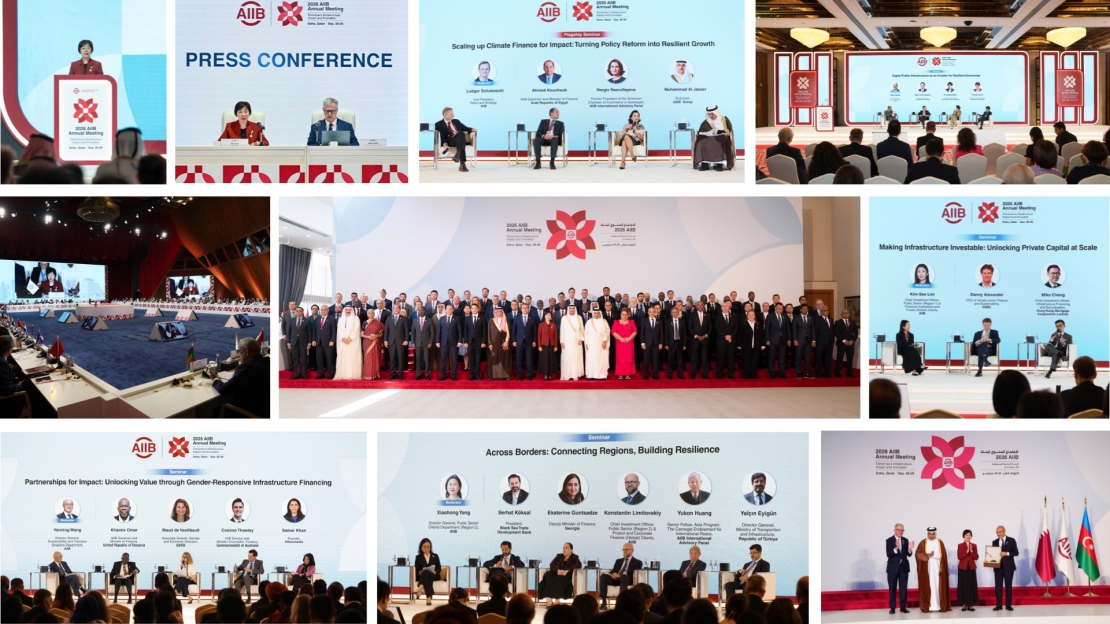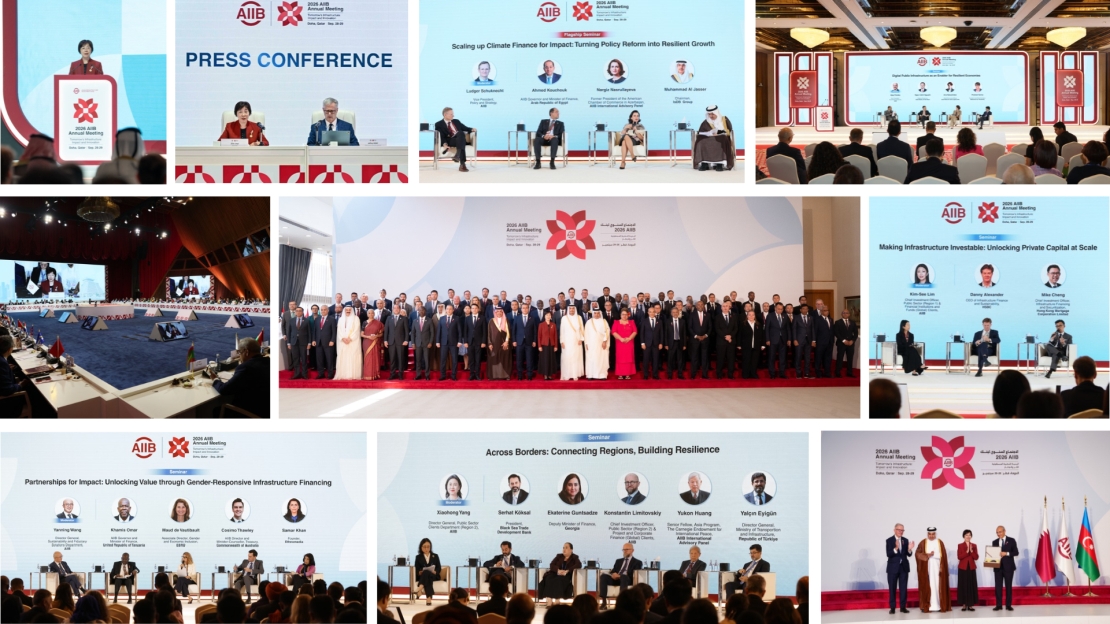
At our 11th Annual Meeting, held in Doha Sep. 28-29, the Asian Infrastructure Investment Bank (AIIB) set out a clear direction for our second decade: scale up development impact with innovation and integrity, respond more directly to members’ needs, and mobilize more private capital for sustainable infrastructure.
Under the theme “Tomorrow’s Infrastructure: Impact and Innovation,” the meeting brought together AIIB members, development partners, civil society organizations (CSOs) and private-sector representatives to discuss how infrastructure investment can deliver greater development value. President Zou Jiayi emphasized that AIIB aims to broadly double annual financing by 2030 to around USD20 billion, focusing on infrastructure that supports climate resilience, renewable energy, digital transformation, regional connectivity, nature conservation and people-centered development.
The program highlighted the importance of translating policy commitments into investment, improving project preparation and mobilizing private capital.
Climate-related financing accounted for 70.6% of AIIB’s total approved financing in 2025, equivalent to USD7.47 billion. Across the program, climate resilience, digital infrastructure, cross-border connectivity and gender-responsive infrastructure emerged as interconnected priorities. Advancing them requires sound policy frameworks, appropriate risk allocation and stronger cooperation among governments, multilateral development banks (MDBs) and private partners, alongside attention to environmental and social considerations and community needs.
Cooperation with members and partners is essential to translating these priorities into action. During the Annual Meeting, AIIB and our counterparts advanced cooperation in climate policy, transport connectivity and longer-term infrastructure planning.
For example, the recent USD1 billion Climate-Focused Policy-Based Financing operation in Brazil supports the government’s Ecological Transformation Plan through policy and institutional measures covering sustainable finance, energy transition, and green and resilient infrastructure. In Georgia, the Trans-Caspian Transport Corridor – Georgia Accessibility and Transport Enhancement Project aims to improve climate-resilient road connectivity and strengthen links to national and cross-border trade corridors. AIIB also advanced our infrastructure cooperation with the Kyrgyz Republic and Uzbekistan through discussions on priority investments and longer-term project pipelines.
These initiatives illustrate how AIIB can work with members to align financing with national development priorities, strengthen project preparation and support infrastructure investment over time.
Engagement with civil society was another part of this cooperative approach. Representatives from 22 economies participated in a dialogue with Zou and senior management, discussing climate finance, transparency, energy-related issues and project-specific matters. A separate exchange hosted by AIIB Vice Presidents Sherard Cowper-Coles, Ludger Schuknecht and Ajay Bhushan Pandey provided further opportunities for dialogue with CSOs.
The discussions in Doha reinforced a central message for AIIB’s second decade: development impact depends not only on financing more infrastructure, but also on improving investment quality and strengthening partnerships.
As infrastructure needs grow and development challenges become increasingly interconnected, AIIB will continue to focus on sustainable, resilient and technology-enabled infrastructure, supported by innovation, integrity and stronger partnerships. These priorities will guide the Bank’s work in the year ahead and beyond, leading to the 12th Annual Meeting, to be hosted by Azerbaijan in Baku July 14-15, 2027.