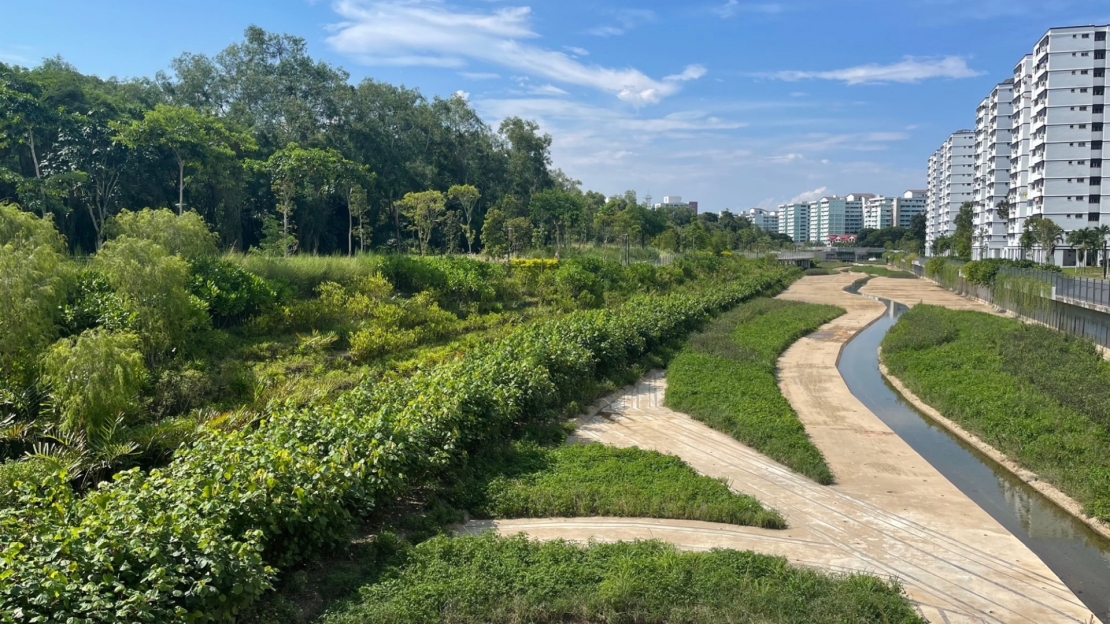

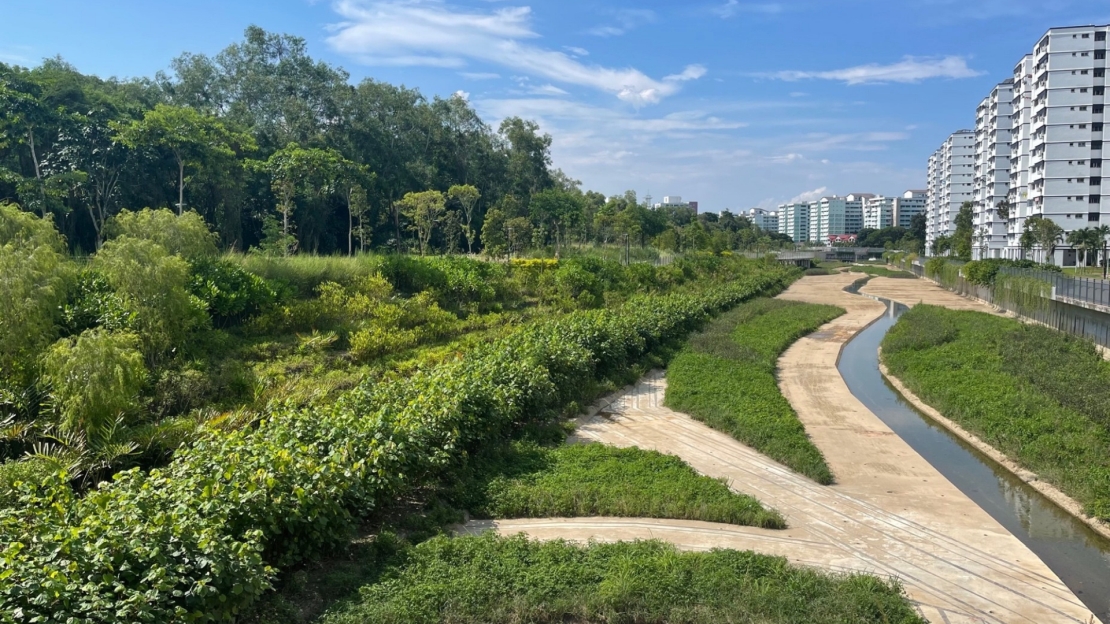
The triple planetary crisis of climate change, biodiversity loss and pollution poses a growing threat to the environment and the economy. Actions are needed to halt and reverse biodiversity loss while advancing sustainable development. As countries implement the Kunming-Montreal Global Biodiversity Framework through their National Biodiversity Strategies and Action Plans, attention is increasingly turning from commitments to implementation. For AIIB, this means identifying practical ways to integrate biodiversity considerations and nature-based solutions (NbS) into infrastructure investments that deliver lasting economic, environmental and social benefits.
This is especially important for infrastructure, where nature is often viewed as a competing priority. Healthy ecosystems underpin infrastructure resilience, performance and long-term value. From reducing flood risks to safeguarding water resources, nature provides essential services that make infrastructure more sustainable and resilient. This aligns closely with AIIB's mission to finance Infrastructure for Tomorrow.
At COP26, AIIB endorsed the Joint Statement by the Multilateral Development Banks: Nature, People and Planet, committing to further mainstream nature across its policies, analysis, assessments, investments and operations. Today, the focus is shifting from why nature matters to how it can be integrated into infrastructure investment, translating commitments into practical solutions from project-level interventions to broader planning and investment frameworks.
One message is becoming clear: nature should not be treated as an afterthought in infrastructure development. The greatest opportunities to protect biodiversity and strengthen resilience often arise before construction begins. Incorporating biodiversity considerations during project screening, preparation and design enables projects to avoid or minimize impacts, better manage environmental and social risks, and enhance long-term performance.
That’s why AIIB is placing greater emphasis on integrating nature early in the project cycle through its Environmental and Social Framework (ESF) and related operational tools, helping identify entry points for biodiversity and NbS during project preparation and design, and supporting more consistent approaches across projects. Early integration often leads to better outcomes and reduces the need for more costly and less predictable biodiversity mitigation measures later in implementation.
An important dimension of this approach is the integration of NbS within a broader “nature as infrastructure” perspective. Rather than viewing ecosystems solely as environmental assets that require protection, this approach recognizes that natural systems, such as wetlands, forests, mangroves and watersheds, can themselves perform critical infrastructure functions. When combined with engineered solutions, these natural assets can improve resilience, reduce risks and generate additional ecosystem service and community benefits.
Realizing these benefits at scale requires making nature more visible in economic and financial decision-making. Integrating biodiversity into infrastructure is not only an environmental objective; it is increasingly an investment consideration.
Natural capital analysis, ecosystem service valuation and the recognition of co-benefits can help better reflect the value of nature within investment frameworks, providing a stronger basis for project appraisal, investment decision-making and the identification of nature-positive opportunities. These approaches help governments, development finance institutions and private investors better understand biodiversity’s contribution to infrastructure performance and long-term value. By strengthening the evidence base for nature-positive investments, they can build a stronger rationale for integrating biodiversity into project decisions.
Financial structuring, derisking mechanisms and supportive institutional frameworks can help mobilize private capital and create a stronger pipeline of bankable nature-based investments. Strengthening these enabling conditions will be critical to expanding nature-positive infrastructure at scale.
These priorities were also explored during an AIIB workshop, “Building Nature into Infrastructure: Creating Opportunities for Biodiversity and Resilience,” held May 22, 2026, to mark the International Day for Biodiversity. Bringing policy, finance and operational perspectives, the event provided a platform to discuss practical approaches for integrating biodiversity and NbS into infrastructure planning, investment appraisal, project implementation and broader investment frameworks.
 |
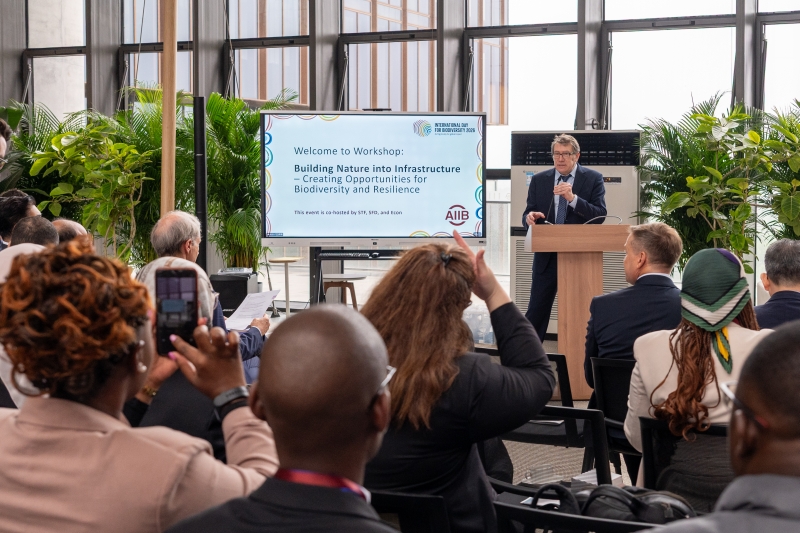 |
Ajay Bhushan Pandey, AIIB’s Vice President, Investment Solutions, underscored that integrating nature and NbS into infrastructure is no longer optional but essential for delivering sustainable infrastructure and long-term economic development. Discussions highlighted that, while project-level innovation matters, achieving meaningful impact also requires stronger institutional capacity, supportive policies, appropriate incentives and effective implementation processes across sectors and markets.
A key takeaway was that embedding nature into infrastructure requires both institutional commitment and practical delivery mechanisms to move from ambition into implementation. More broadly, participants recognized nature as a core component of investment quality, resilience and long-term value creation. Recognizing the value of biodiversity in principle is not enough. Organizations also need the tools, methodologies, systems and partnerships required to apply that understanding consistently across projects.
Continued biodiversity loss and ecosystem degradation ultimately undermine the foundations of economic growth, human well-being and infrastructure resilience. While methodologies and approaches for nature-positive investment continue to evolve, waiting for perfect solutions is not an option. The challenge now is to build on this growing momentum, turning ideas into systems, pilots into practice and commitments into lasting change. By embedding biodiversity considerations and NbS throughout the investment cycle, AIIB can help members build infrastructure that supports development while safeguarding the natural systems on which communities, economies and future generations depend.