
The Asian Infrastructure Investment Bank (AIIB) is looking for graduates and young professionals who are interested in working on infrastructure development. As a multilateral development bank (MDB) focused on developing Asia, but with Members from all over the world, AIIB’s investments in infrastructure and other productive sectors seek to foster sustainable economic development, create wealth and improve infrastructure connectivity.
AIIB’s Graduate Program, a two-year rotational program, will give successful candidates an opportunity to gain experience in one of the five streams: Investment, Finance, Risk Management, Strategy, and Corporate. It also has a parallel Legal Associate program for young lawyers who want to work with the Legal Department.
AIIB first opened the program in 2022 and admitted 25 Graduate Program associates from a pool of 5,039 applicants worldwide (from 123 economies). The first cohort is composed of 19 female and 6 male young professionals from 16 economies (Cambodia, Canada, China, France, India, Indonesia, Korea, Malaysia, Mongolia, Norway, Pakistan, Philippines, Romania, Russia, United Kingdom, and Viet Nam). All of the successful candidates are multitalented young professionals, with excellent academic track records and interested in contributing to international development, particularly in Asia.
AIIB is committed to diversity and inclusion, both in terms of encouraging more women applicants and applicants from all over the world. The Bank’s strength comes from having a team with a diverse set of skills, experiences and abilities selected through a merit-based competitive process. It actively encourages applications from people from both within and outside AIIB members, regardless of nationality, religion, gender, race, disability, or sexual orientation.
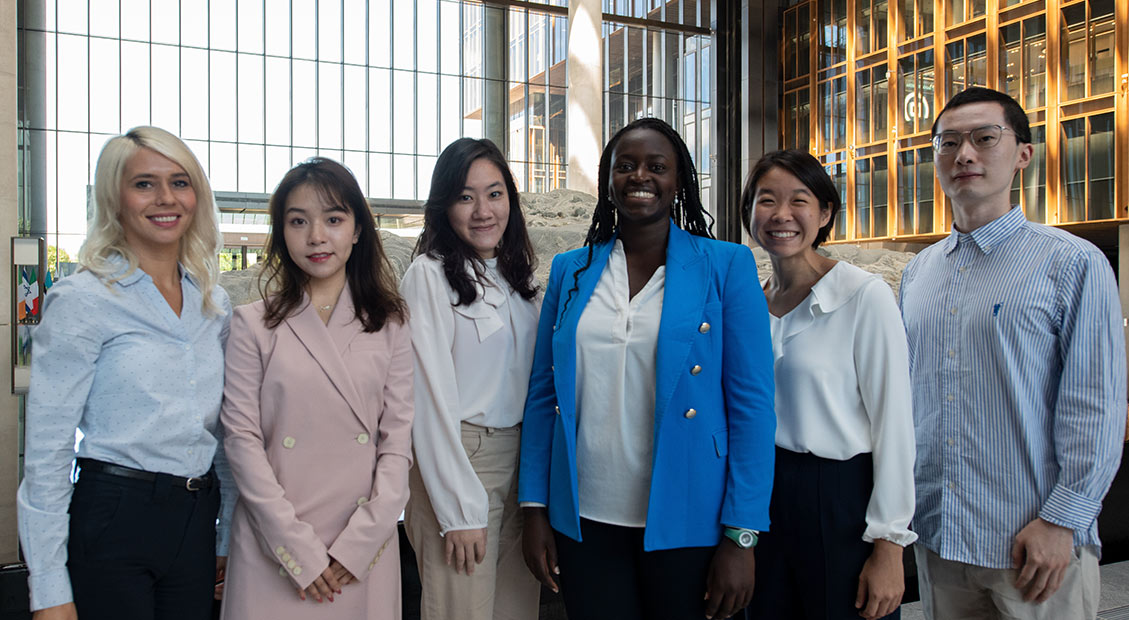
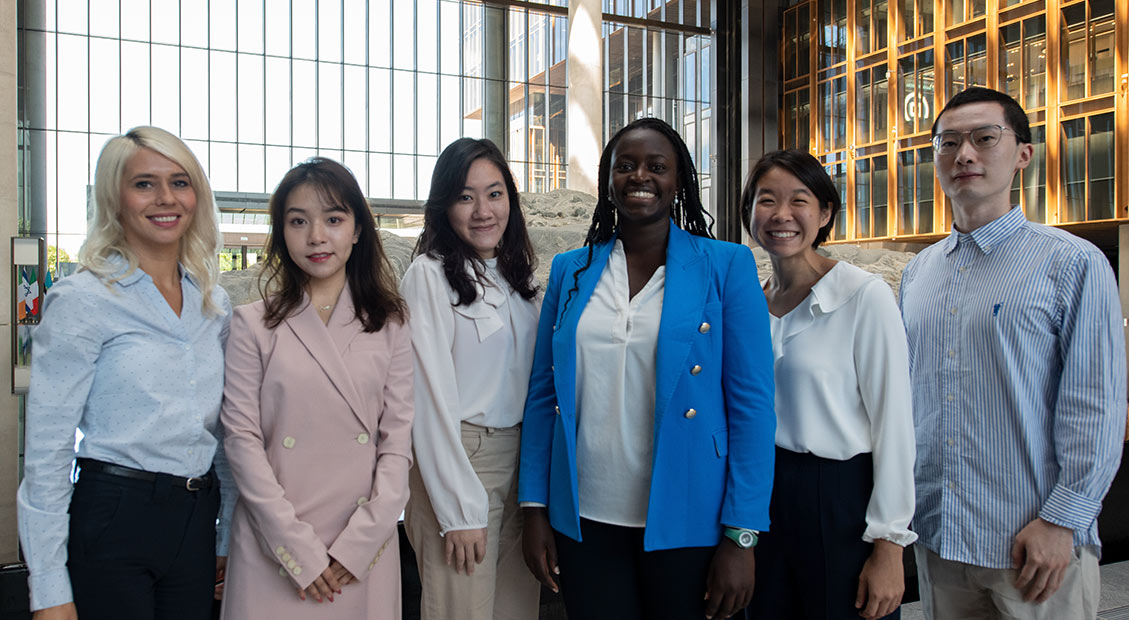
Meet some of AIIB’s Graduate Analysts:
Crina Irina Cinta, Sue Yin Chua, and Alliance Niyigena are all pursuing the Finance Track: both Crina and Sue are with the Office of the Controller while Alliance is with the Office of the Treasurer.
Crina, who is from both Italy and Romania, has a bachelor’s degree in economics and a master’s degree in intermediaries, international finance and risk management, both from the La Sapienza University of Rome, as well as a master’s degree in banking and asset management from HEC–Management School, University of Liege (Belgium). As part of AIIB’s Loan Management Unit, one of her main tasks is to contribute to the enhancement of the Bank’s investment and loan administration capacity to ensure seamless operations as well as build the loan management system.
She said, “Although I never thought about jobs in Asia before, I thought that this was a wonderful opportunity for my career growth. The fact that AIIB is a new MDB convinced me to apply since I thought I could contribute and work on projects and processes that I could never do in an MDB or an UN agency where all the processes are already established.
“Moving to China meant stepping out of my comfort zone and coming to grips with an entirely new culture. The biggest challenge of moving to Beijing was not knowing Mandarin, but I must say that people here are really welcoming and friendly. To live in a completely new environment, you need to have an open mind and be very curious, ready to accept and appreciate all the cultural differences you might find every day,” she continued.
According to Sue Yin, “Growing up in Malaysia, I’ve always been interested to give back and contribute to Asia’s development.” After obtaining her master’s degree in chemical engineering from the University of Birmingham, UK, she began her career in the oil and gas sector, starting out as a process engineer in manufacturing before moving on to the business controller side of the business. This experience resulted in her decision to pursue a master’s degree in business administration from the University of Illinois Urbana-Champaign.
She first learned about AIIB from the news. “My interest in the organization was mainly because of its focus on infrastructure development in Asia and its lean, green and clean operating principles. I have long-term career goals to pivot into the development field and AIIB’s rotational program provides the perfect training ground to learn, understand and contribute to the industry.” Her typical workday includes monitoring, reviewing and processing corporate expenses and coordinating across departments for process troubleshooting and improvement. “However, no one day is the same which is also the exciting part of the job.”
When asked what would help future candidates be a success in the role, she responded, “Flexibility, willingness to learn and great interpersonal skills are some of the important qualities to be able to work in such a fast-paced and multicultural environment. My current team consists of 10 members from 5 nationalities. Despite our diverse backgrounds, everyone collaborates effectively to address new issues and move things forward.”
Alliance’s career began as an engineer, having earned a double master’s degree in Electrical and Mechanical Engineering from the University of Edinburgh, and having worked as an engineer in Spain on electronics for renewable energy technologies. Her interest in the global impacts of the energy transition led her to take a master’s degree at Tsinghua University in Beijing to learn more about international finance and global affairs. From there, it was an easy decision to apply to AIIB’s Graduate Program. Currently, she is a Treasury Analyst with the Office of the Treasurer, assisting the Funding team with day-to-day funding transactions, developing the AIIB Sustainable Development Bonds Impact Report and improving AIIB’s engagement with investors on environmental social and governance (ESG) concerns. She is from Norway.
“The Graduate Program at Asian Infrastructure Investment Bank provided an opportunity to combine my background in engineering and sustainability with finance,” said Alliance. “It is a unique opportunity for early career individuals to gain access to the multilateral banks. I also like that the Program provides an opportunity to rotate to other departments, to gain a broader understanding of the operation of the Bank. In the future, I want to keep working at the intersection between infrastructure and finance; thus, the opportunities for growth with the Graduate Program are launching me in the right direction.”
Before joining AIIB, Boyang Sun worked as a research analyst at the International Monetary Fund (IMF) in Washington DC, monitoring and analyzing Euro Area’s macroeconomy and capital markets. He holds a master’s degree in international economics and finance from the Johns Hopkins University–School of Advanced International Studies (SAIS). He is currently working as a counterparty credit risk analyst with the Risk Management Department of AIIB.
About AIIB’s culture, he noted that it is “super inclusive with international employees coming from all around world. All the colleagues I met are pretty kind, always willing to provide any help we might need and share valuable career advice with us young analysts. I believe everyone in AIIB can thrive here.”
Young talents who are interested in applying to the AIIB Graduate Program should:
- Have a Master’s degree with at least one to two years of relevant working experience OR
A Bachelor’s degree with at least two to three years of relevant working experience. - Be fluent in oral and written English.
- Meet the criteria of the specific positions in each department.
For more information about the AIIB Graduate Program and to apply online, visit the AIIB Career Opportunities site. Deadline for application submission is February 5, 2023.
Register for the virtual event on Graduate and Legal Associate Program on Jan. 20, 2023. A platform for young and entry-level professionals to engage directly with AIIB HR representatives, current Graduate Analysts and Legal Associates. For more information, visit AIIB’s page on Impactpool.