
As the global economy faces challenges caused by recent crises, multilateral financing institutions play a key role in mobilizing investments to help developing countries recover and meet sustainable development objectives.
While the emergence of more multilateral institutions such as the Asian Infrastructure Investment Bank (AIIB) means “more hands on deck,” the investment basket can only provide so much. Cooperation, not competition, will help ensure investments are optimized, sustainable and aimed at countries that need them most.
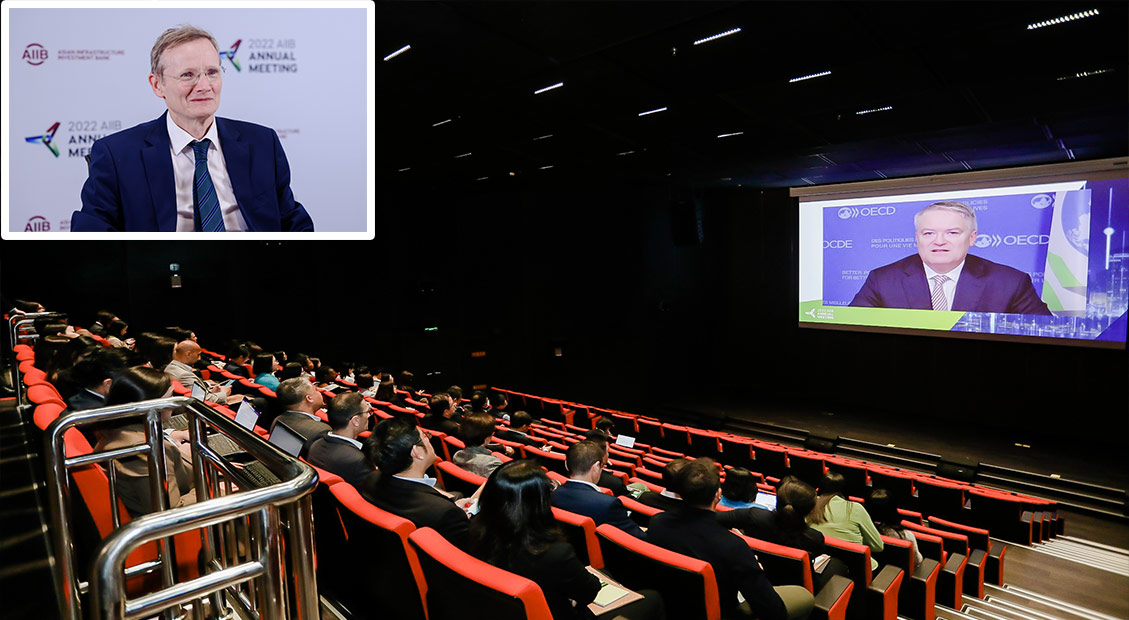
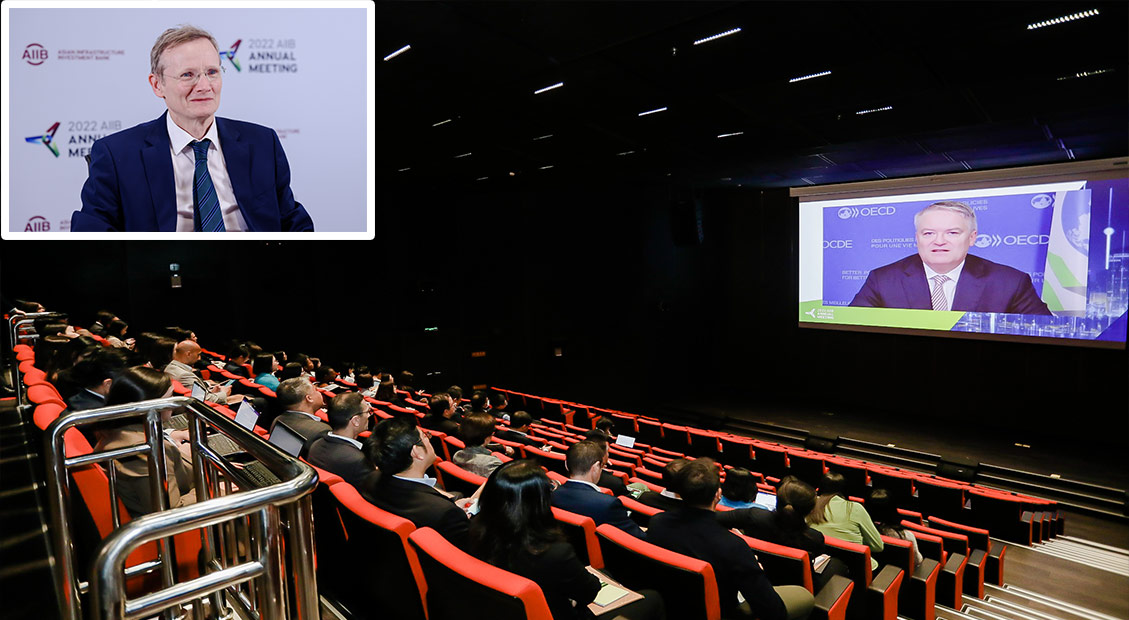
“There remains so much work to be done on this front and we truly need all hands on deck to help us reach our development objectives,” says Mathias Cormann, Secretary General of the Organisation for Economic Co-operation and Development (OECD), speaking during a session at the recent 2022 Annual Meeting of the AIIB Board of Governors titled “Building Modern Governance for Effective Multilateralism.”
Cormann himself noted that this year’s AIIB Annual Meeting comes at a time of shared challenges and uncertainty in the global economy, as the Russia-Ukraine conflict has slowed down growth and triggered broad-based inflation. Meanwhile, COVID-19 measures continue to disrupt supply chains in Asia with global consequences, particularly for lower- and middle-income countries.
“We must grapple with these pressures in the short term while laying the groundwork for the sustainable transition of our economies over the long run. We must do so in support of the growth aspirations of developing economies,” Cormann says.
OECD estimates around USD6.9 trillion will be needed each year through to 2030 to meet the United Nations Sustainable Development Goals. Collectively, at present, global investment is falling short by around USD3.4 trillion to USD4.4 trillion.
Clearly, no single country or multilateral development bank (MDB) can make up for this investment gap, while tackling such shared challenges—including climate change and environment sustainability—on its own.
Multilateral cooperation is essential in providing collective responses required for these shared challenges. Common standards are important to optimize the effectiveness of multilateral actions.
Cormann highlights three areas of relevance to AIIB where multilateralism and international standards can help improve outcomes.
First, improved donor coordination. While the multilateral development architecture is now more crowded and fragmented than ever, more donor contributions are earmarked, limiting flexibility and putting pressure on multilateral organizations to rely on new funding models, including private finance.
Second, it is important to recognize not just the amount, but the quality of that investment. Common policy frameworks across governments and MDBs are needed to ensure investments are aligned with shared objectives.
Finally, there is a need to incorporate resilience explicitly in the work of multilateral institutions to ensure infrastructure projects are sustainable in the long term and able to manage and mitigate risks.
“There will always be limited resources deployed by multiple players. We really need to do everything we can to optimize impact. That’s where global cooperation and coordination comes in,” Cormann says.
While AIIB is considered a “young” institution having started almost seven years ago, it has earned its place within the MDB community, with 191 projects implemented in 35 countries at around USD36.44 billion worth of lending.
AIIB has also proven to be very adaptable, being one of the first MDBs to respond to the pandemic with its COVID-19 Crisis Recovery Facility.
With 105 members at present, this shows “buy in” from around the world for AIIB, says Professor Ngaire Woods, Inaugural Dean of the Blavatnik School of Government and Professor of Global Economic Governance at Oxford University.
Woods also gives credit to AIIB’s governance structure in its objective becoming a “lean, clean and green” bank. In 2021, 88 percent of the Bank’s lending was aligned with its green infrastructure objective.
“Multilateral banks, if we are being honest, have problems,” says Woods. “They have boards which try to micromanage every loan. They have a problem of accountability, because who is it making all the lending decisions—is it all countries trading off with each other or is it the ineffective technocratic management?”
“AIIB has tried something bold on that. It is delegating some of the decisions to management. It is overseeing the President and the quality of management—and it is doing well,” Woods explains, while noting that AIIB has successfully navigated through geopolitical pressures and the COVID-19 pandemic.
Dr. Ludger Schuknecht, AIIB Vice President and Corporate Secretary, points out that the Bank’s AAA rating reflects not just good finance, but also good governance.
As Schuknecht explains, AIIB’s shareholding is roughly 25 percent of the votes from advanced countries, about a quarter for China and the rest for both advanced and emerging Asian economies.
“In this environment, our most important decisions are supramajority decisions which require 75 percent of the votes, so no group can dominate. We all must work together to forge consensus to agree and work toward the high standards of the Bank,” Schuknecht points out.
Nonetheless, even with a good record so far, Schuknecht says the Bank has a lot to learn and is committed to working with partners, clients and stakeholders to deliver projects with high quality. He also acknowledges that as a young institution, AIIB needs to focus on internal capacity and is regularly reviewing its governance structure.
“We must keep the integrity of our governance. It’s ultimately the governance that determines the quality of the outcome and delivery of objectives,” Schuknecht says.
For Woods, an area where AIIB can make the most significant contribution is being a facilitator of cooperation among multilateral institutions and governments.
“In a world fragmenting quickly, we need more institutions where countries can come together to cooperate, particularly in the face of global challenges,” Woods says.
Watch the session replay on AIIB’s YouTube channel.