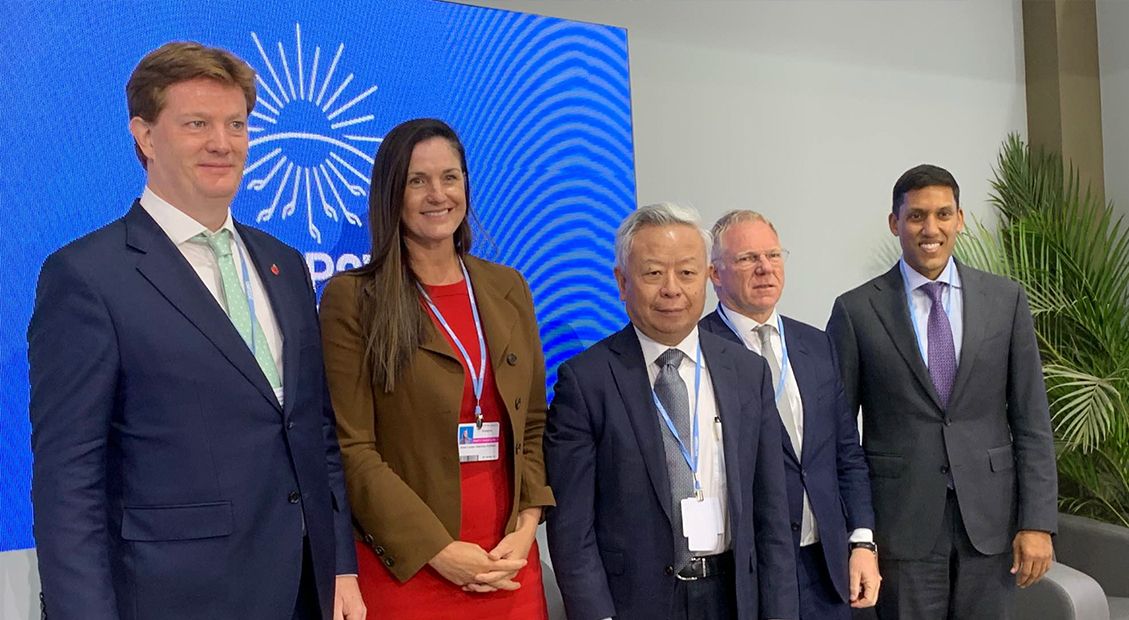

The flagship event of the Asian Infrastructure Investment Bank (AIIB) at COP27—Scaling Climate Finance–Bridging the Gap Between Concessional and Private Finance—was held on Nov. 8 and opened by Jin Liqun, AIIB President and Chair of the Board of Directors of AIIB. Key points and context:
- The significant gap in financing (trillions of dollars) to keep to 1.5 degrees by 2030 was underscored. The Intergovernmental Panel on Climate Change concluded that the current level of financial flows is 3 to 6 times lower than needed. Compounding the situation is the fact that there is both a disproportionate distribution of financing, with not enough flows to developing countries, and too little contribution from the private sector which has the financial resources needed to address climate change.
- The current macroeconomic context will further squeeze the availability of public finances and constrain private sector financing appetite. Combined with the shocks of volatile energy prices, COVID-19 and increasingly severe climate events, this situation is of particular concern to developing countries, including in AIIB’s region. Given that Asia is a region disproportionally impacted by climate change, as we have seen by the recent tragic events in Pakistan, it is now even more important for private capital to be scaled up to play a meaningful role in climate finance in developing countries.
- In order to help scale up and bridge the gap in financing, we need to maximize capital mobilization and increasingly work together and capitalize on each other’s strengths.
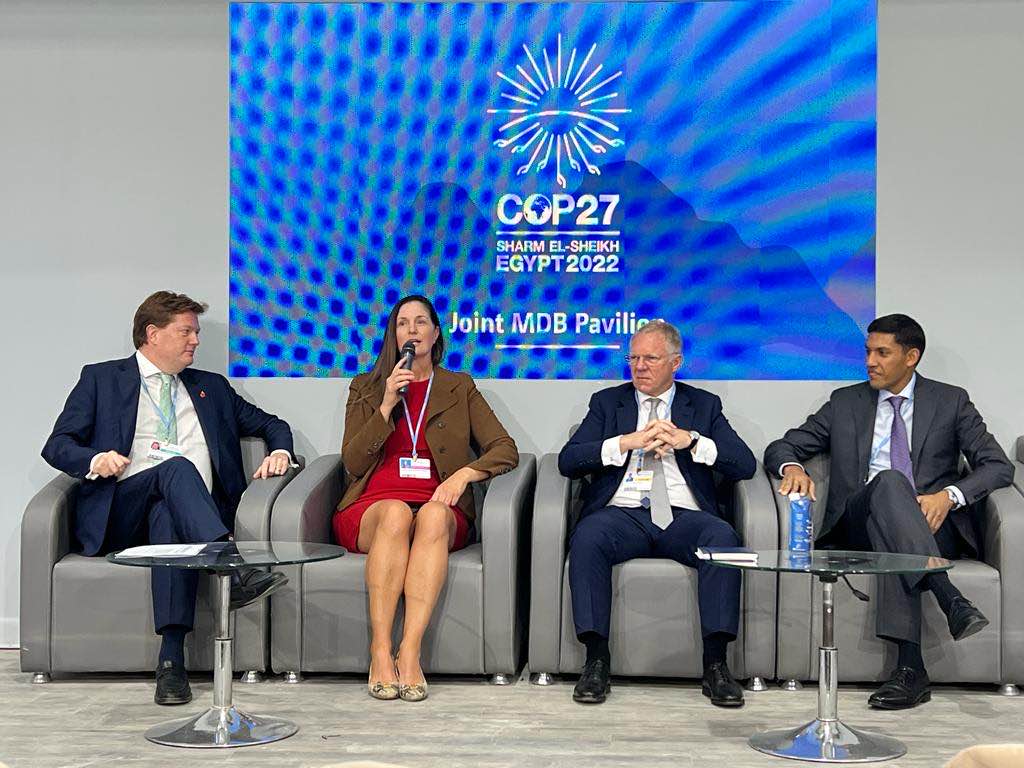
His opening remarks were followed by a discussion moderated by Sir Danny Alexander. Members of the panel included Anne Valentine Andrews, Global Head of Infrastructure and Real Estate at Blackrock; Mark Dooley, Global Head of the Green Investment Group at Macquarie and Rajiv Shah, President of the Rockefeller Foundation. The panelists shared their respective experiences and discussed how we can scale climate finance via new models and partnerships. Please do view the recording at AIIBatCOP27: Scaling Climate Finance—Bridging the Gap Between Concessional and Private Finance - YouTube.
The three partnership models presented were:
- Blackrock’s Climate Finance Partnership, Innovative partnership and financing structure
- Macquarie’s Green Investment Group, Public and private finance mobilization
- Rockefeller Foundations GEAPP
The speakers responded on the imperative of adaptation and resilience action as 1.5 degrees does not seem in reach with the current climate commitments on the table. Rajiv Shah responded, saying development investment is adaptation investment.
There is much more to reflect upon in terms of priorities and challenges discussed.
AIIB also signed both the GEAPP and the Egypt NWFE Energy Pillar Partnership Agreement initiatives on Nov. 8. Read the story here.
Parallel to the flagship event, the COP27 negotiations and their implications for country negotiators have been discussing the following:
- Loss and damage as a result of climate events such as flooding, was a sticking point on the agenda. Due to the inevitability that we will not be achieving the 1.5-degree scenario, developing countries would like a facility to fund loss and damage. The negotiators were only able to move ahead with this item on the understanding that there is no obligation for payment.
- A mitigation work program is being put together to address the ambition gap. There has also been some progress on discussions around Article 6 (carbon markets) with the development of a technical paper to operationalize the rulebook that came out of COP26. There is an element of the technical paper about baseline determination for Paris Alignment that AIIB’s Climate Team believes may even support the Bank in our Paris Alignment operationalization.
- In terms of the USD100 billion discussion, a new goal is being determined for 2027 or 2029. Separately there is also a call for doubling adaptation finance. A debate ensues on definitions of climate finance. Climate finance figures differ significantly. Oxfam’s estimates are USD20 billion and OECD estimates USD80 billion. On adaptation finance ambitions, there is a question of what is meant by doubling—from when? On adaptation, SIDS raised major issues with the lack of disbursements from the adaptation fund and the difficulty of accessing GCF finance.