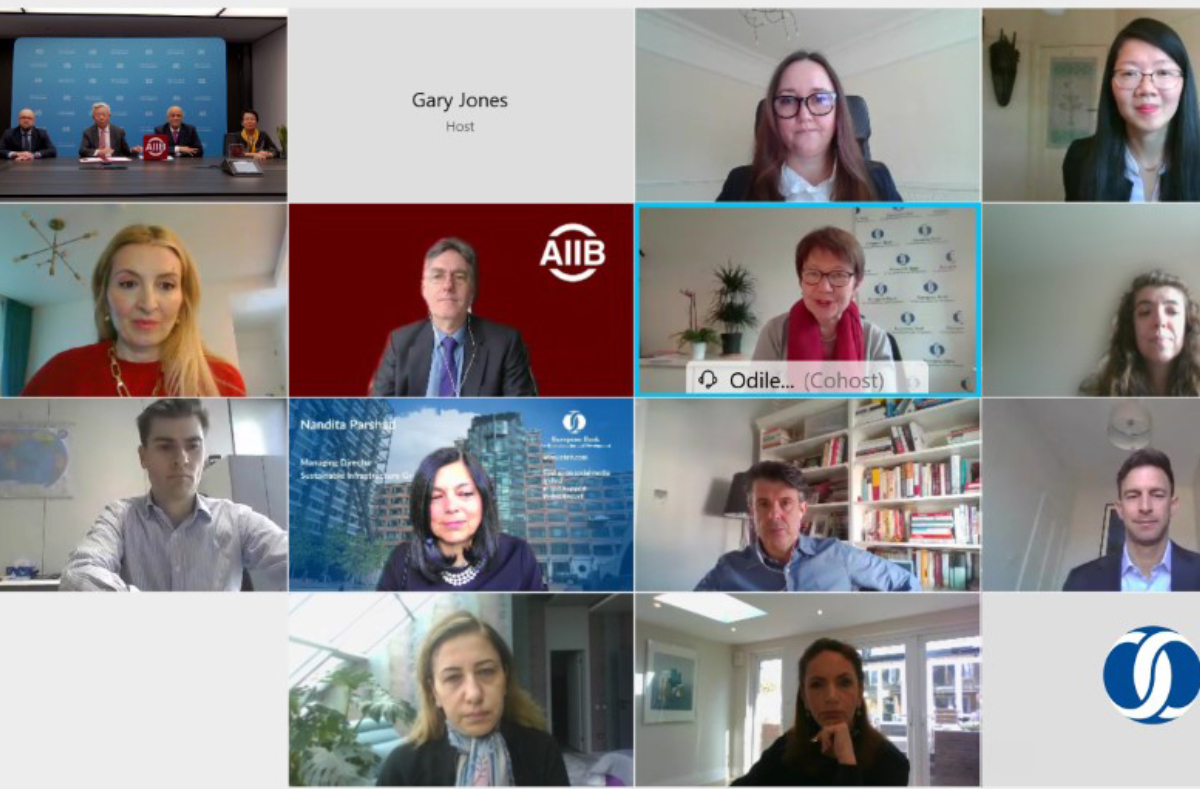

Last April 6, 2021, the European Bank for Reconstruction and Development (EBRD) and the Asian Infrastructure Investment Bank (AIIB) signed a co-financing framework agreement (CFA) which laid the foundation for future joint activity. However, it would be fair to say that the existing level of partnership is exemplary.
The EBRD, which has just celebrated its 30th anniversary has been, until recently, the youngest institution in the world of international financial institutions (IFIs). Despite being an IFI, we have a private sector focus and mentality. Our Bank is evolving. We maintain strong presence on the ground in each country of operation and keep on expanding our activity to new markets. The EBRD is flexible in adjusting its financial instruments to the unique needs of our clients. These are our trademark qualities, which helped us shape our partnership with AIIB over the last five years. Not only is AIIB taking on board our experience but we are also giving AIIB our DNA as many ex-EBRD professionals have moved to Beijing to work for AIIB. For myself, it has been a privilege to work with AIIB on several projects we co-financed and I am confident there is a big potential for cooperation in the future. The bond is strong and long it may continue.
Officially, the domains where the two institutions operate are different. However, despite EBRD being headquartered in Europe and AIIB in Asia, our activities overlap and create synergies. Let us take the green agenda as an example of a goal shared by both IFIs. It will require significant investments and many of the economies where we work will rely heavily on long-term capital providers such as EBRD and AIIB. In this respect, EBRD’s partnership with AIIB seems to be the natural and perfect fit: we can finance long-term ambitious undertakings together or jointly with other development or commercial banks.
The EBRD has a lot to offer: its in-depth local knowledge, long track record of policy work and innovative project tools like renewable energy auctions and public private partnerships (PPPs). AIIB, for its part, has a strong presence in the Asian market and can effectively mobilize leading regional players.
As global ambition for decarbonisation is quickly advancing, it is very important that partner IFIs are aligned in their approach to help countries accelerate their transition to clean energy. It is crucial for us to share information and knowledge to make sure most complex projects follow best practice and come to fruition.